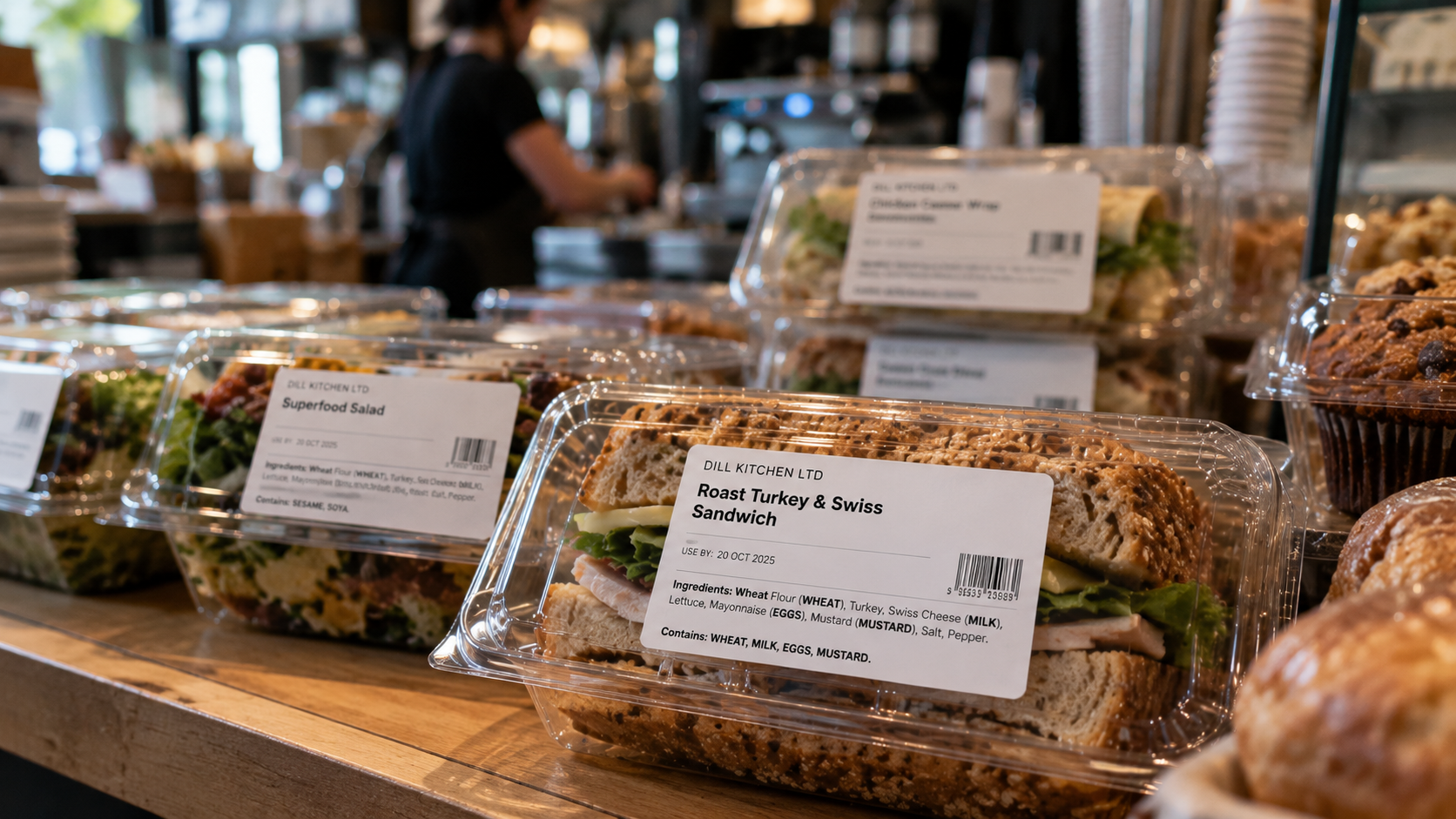
It's 6am. Someone on the opening shift is wrapping turkey sandwiches, snapping lids on salads and boxing croissants for the cooler and the counter by the register. By 7am those packs are on the shelf, and every one of them is a packaged food under the rules your health inspector works from.
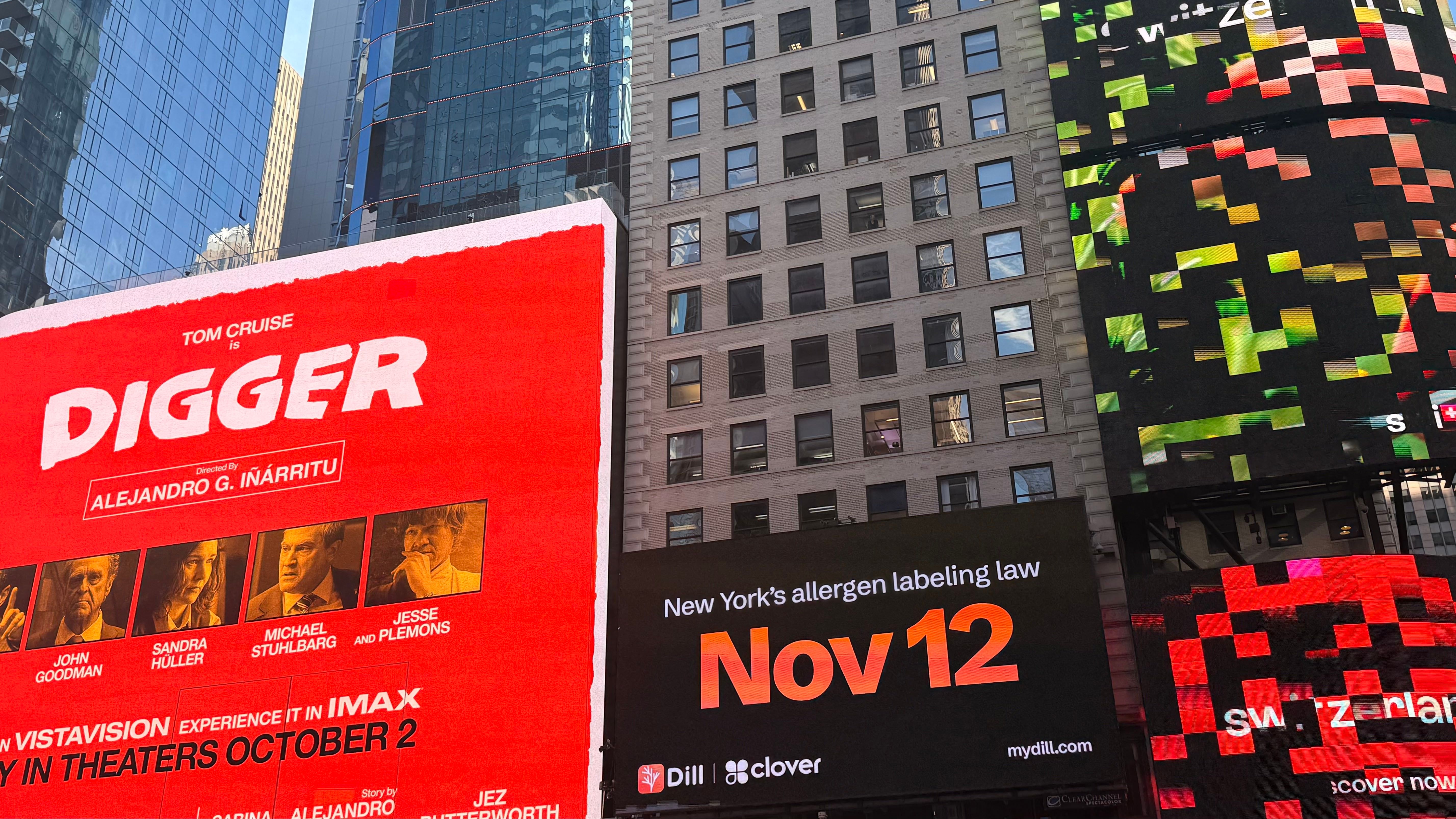
Most pages on grab-and-go labeling requirements cite no Food Code section or federal regulation. This one cites both. And if you operate in New York, there is a date to circle: a new state allergen labeling law takes effect on 11/12/2026.
Grab-and-go labeling in 60 seconds
- Food packed before a customer orders is packaged food. Food wrapped at the customer's request is not.
- The FDA Food Code is a model, not federal law. Your state or local government adopts it and your health inspector enforces it.
- Food Code 3-602.11 lists the label elements: name, ingredients, net quantity, business name and place, allergens, and nutrition labeling unless exempt.
- Declare the nine major allergens in parentheses or a "Contains" statement, naming the specific nut, fish or shellfish.
- Most independents are exempt from Nutrition Facts. Chains with 20+ locations still show calories.
- The 7-day date marking rule is back-of-house, not a consumer label rule.
- New York requires an allergen notice on prepackaged food from 11/12/2026.
What counts as grab-and-go (packaged) food
Under the Food Code, "packaged" means bottled, canned, cartoned, bagged or wrapped. The key exception: food wrapped or put in a carry-out container by an employee at the customer's request is not packaged.
So the test is simple. Was it packed before anyone ordered it?
- A sandwich made at 6am and put in the cooler: packaged, needs a label.
- A sandwich made to order and wrapped while the customer waits: not packaged under this definition.
- Muffins boxed in clamshells on the counter: packaged. The Illinois Department of Public Health says pre-packaged bakery items made on-site must meet all labeling requirements, including allergens.
Bulk and self-serve food has its own rules (3-602.11(C) and (D)). Self-serve bulk food needs a label or sign in plain view. Unpackaged bulk bakery items need no label if you make no claims, no local law requires one, and you made them on premises or at a regulated site you own.
For items made to order, see our guide to made-to-order labels.
Who actually sets and enforces the rules
FDA says it plainly: "The model Food Code is neither federal law nor federal regulation." It is written for adoption by state and local governments.
Adoption is uneven. According to FDA's adoption tracker, as of 2024, 11 state agencies in 7 states had adopted the 2022 edition, covering 16.06% of the US population. 46 state agencies in 36 states had adopted one of the three most recent editions (2022, 2017 or 2013). FDA released a 2026 edition in September 2026. Some states run their own codes instead.
In practice, for food made and sold in one store, the rules reach you through your state or local food code. Its section 3-602.11 points back to federal labeling law (21 CFR 101), and your health inspector checks it. Find out which edition your state uses.
What has to be on the label: the 3-602.11 checklist
Food Code 3-602.11(A) says food packaged in a food establishment must be labeled as specified in law, including 21 CFR 101. Part (B) spells out the elements. As adopted by states such as Virginia, the label needs:
- Name of the food. The common name, or an adequately descriptive statement of identity.
- Ingredients. For foods with two or more ingredients, list them in descending order of predominance by weight, including sub-ingredients and any artificial color, artificial flavor and chemical preservatives.
- Net quantity. An accurate declaration of net quantity of contents.
- Business name and place. The name and place of business of the manufacturer, packer or distributor.
- Major allergens. The food source of each major food allergen, unless it is already part of an ingredient's common name.
- Nutrition labeling. Required under 21 CFR 101, unless you are exempt (more on that below).
- Salmonid color additives. If you sell salmonid fish containing canthaxanthin or astaxanthin as a color additive, you must disclose it.
One caveat: enforcement of net quantity and address on items sold by count, like a single sandwich, varies. Some state weights-and-measures rules allow a count. Check locally rather than dropping either line. And the retail ingredient exemptions in 21 CFR 101.100 don't cover food you make and pack in the store.
How to declare the 9 major allergens
The nine major food allergens are milk, eggs, fish, crustacean shellfish, tree nuts, peanuts, wheat, soybeans and sesame. Sesame became the ninth on 01/01/2023 under the FASTER Act. FDA says food packaged at retail must declare the major allergens it contains, including sesame.
Per FDA's allergen guidance, the food source has to appear at least once, in one of two ways:
- In parentheses after the ingredient name, for example "lecithin (soy)" or "butter (milk)".
- In a "Contains" statement immediately after or next to the ingredient list, for example "Contains: Wheat, Milk, Soy".
Be specific. "Tree nuts" is not enough: name the nut (almonds, pecans, walnuts). The same goes for fish species (bass, flounder, cod) and crustacean shellfish (crab, lobster, shrimp).
If you use a Contains statement, list every major allergen in the product, even ones obvious from the ingredient names.
Do you need a Nutrition Facts panel?
Most independent grab-and-go operators don't. Two exemptions in 21 CFR 101.9 do the work.
The small business exemption, 101.9(j)(1)(i). A retailer selling direct to consumers with annual gross sales to consumers of not more than $500,000 is exempt, provided the food carries no nutrition claims or other nutrition information on the label, in labeling or in advertising.
The made-on-premises exemption, 101.9(j)(3). Ready-to-eat food that is processed and prepared primarily in a retail establishment, offered for sale but not for immediate consumption, and not sold outside that establishment is exempt. The classic example is a deli sandwich made in store and sold only there.
Both exemptions disappear if the label carries a nutrient claim or other nutrition information. Interpretations of "primarily" prepared on premises vary, for example for a sandwich built from bought-in components, so ask your inspector if that's you.
Chains with 20 or more locations
The 101.9(j)(3) exemption opens with "Except as provided in § 101.11." Section 101.11 is menu labeling. If you are part of a chain with 20 or more locations, you are a covered establishment, and standard menu items that are self-service or on display must show calories per displayed item or per serving, on a sign next to the food or on the label. So a covered chain still owes calories on its grab-and-go items, even when a full Nutrition Facts panel isn't required.
Date marking vs "use by" dates
Date marking under Food Code 3-501.17 is a food safety control, not a consumer label requirement. It applies to ready-to-eat TCS food held longer than 24 hours. That food must be marked and can be held at 41°F (5°C) or below for a maximum of 7 days.
FDA guidance says a date marking system can use calendar dates, days of the week, color-coded marks or other effective means. A sandwich made and sold the same day doesn't need a date mark under 3-501.17. See our guide to day dots and the 7-day rule.
Many operators still add a "use by" date to grab-and-go packs. That's good practice, and some local health departments require one, so check locally.
New York: allergen labeling from 11/12/2026
New York's S5381B (Chapter 494 of the Laws of 2025) adds Public Health Law 1357, covering places like delis, bakeries and sandwich shops, and Agriculture and Markets Law 199-g, covering retail food stores. It was signed on 11/12/2025 and takes effect one year later, on 11/12/2026.
It defines "prepackaged food" as food that is prepared, prepacked and offered or sold to customers on the same premises. It excludes food not in packaging or packaged after a customer has ordered. Every food establishment must label all prepackaged food with a written notice identifying any ingredient that is a major food allergen. The list matches the federal nine, and highly refined oils are excluded.
The law requires allergens only, with no full ingredient list and no prescribed format, font size or "Contains" wording. For the details, read our breakdown of New York's allergen labeling law.
Two example grab-and-go labels
Both examples assume a single independent store with sales of $500,000 or less, or relying on the made-on-premises exemption, with no nutrition claims. So no Nutrition Facts panel. Ingredients are illustrative only. Always check supplier specs for each component.
Example 1: Turkey and Swiss sandwich (Contains statement format)
TURKEY & SWISS SANDWICH
Ingredients: Wheat bread (wheat flour, water, sugar, yeast, soybean oil, salt), turkey breast (turkey, water, salt, sodium phosphate), Swiss cheese (milk, salt, cultures, enzymes), lettuce, tomato, mayonnaise (soybean oil, eggs, vinegar, salt, lemon juice)
Contains: Wheat, Milk, Egg
Net Wt. 8 oz (227 g)
Prepared by Main Street Deli, Springfield, ST 00000
Use by: 10/13/2026
Illustrative example only.
Why no soy? Highly refined soybean oil isn't treated as a major food allergen. If the bread contained soy lecithin, soy would go in the Contains line.
Example 2: Almond croissant (parentheses format)
ALMOND CROISSANT
Ingredients: Wheat flour, butter (milk), almond filling (sugar, almonds, eggs, butter (milk), wheat flour), water, sugar, eggs, yeast, salt, sliced almonds
Net Wt. 3.5 oz (99 g)
Prepared by Main Street Bakery, Springfield, ST 00000
Illustrative example only.
Every allergen is named in the list: wheat and eggs by name, milk in parentheses, and "almonds", not "tree nuts". A Contains statement would read "Contains: Wheat, Milk, Egg, Almond".
Decision flow: what does this item need?
- Packed before the customer ordered? No: not packaged food under the Food Code. Yes: go on.
- Add the core elements: name, ingredients by weight, net quantity, business name and place, major allergens.
- Chain with 20+ locations? Yes: show calories under 21 CFR 101.11.
- Any nutrition claim on the pack, labeling or ads? Yes: you likely need Nutrition Facts.
- Sales of $500,000 or less, or made primarily on premises and sold only there? Yes: likely exempt from Nutrition Facts. No: ask your inspector.
- Ready-to-eat TCS food held more than 24 hours? Yes: date mark it, max 7 days at 41°F or below.
- Local extras? Check use-by dates, count vs weight, and in New York the allergen notice from 11/12/2026.
What's still unclear
- Which Food Code edition applies. It depends on your state, county or city.
- New York guidance. Official guidance hadn't been published at the time of writing. Our New York guide will track it.
- The new 2026 Food Code. FDA released a 2026 edition on 09/17/2026. Its summary of changes lists no change to 3-602.11 or the 3-501.17 date marking text, but it will take time for states to adopt it.
How Dill handles it
Dill keeps your recipes, ingredients, allergens and shelf lives in one place. Staff pick the item on a tablet or phone, and the label prints with the right allergens, dates and who made it. Change a recipe once and it reaches every site. Dill connects to POS data from Clover and Lightspeed, so products aren't retyped, and prints prep and rotation, grab-and-go and made-to-order labels. It runs on Brother label printers, with other hardware on request. Hundreds of businesses use Dill, with thousands of sites between them and over 65 million labels printed.
Dill helps you print consistent labels. It doesn't replace checking your own state and local rules.
FAQ
Is the FDA Food Code federal law?
No. It becomes enforceable when your state or local government adopts it.
Do I need to label a sandwich I wrap while the customer waits?
Not under the Food Code: food wrapped at the customer's request isn't "packaged" food. New York's law also excludes food packaged after a customer orders.
Do grab-and-go items need a Nutrition Facts panel?
Often not. The $500,000 small business and made-on-premises exemptions cover most independents, as long as you make no nutrition claims.
Do chains have to show calories on grab-and-go food?
Yes, chains with 20 or more locations (same name, substantially the same menu) must show calories on self-service and displayed items under 21 CFR 101.11.
Should I use "Contains" or parentheses for allergens?
Either works. A Contains statement must list every major allergen in the product.
Is a "use by" date legally required?
Not by the Food Code itself, but some local health departments require one, so check locally.
What changes in New York on 11/12/2026?
Prepackaged food made and sold on the same premises needs a written notice of any major food allergens.