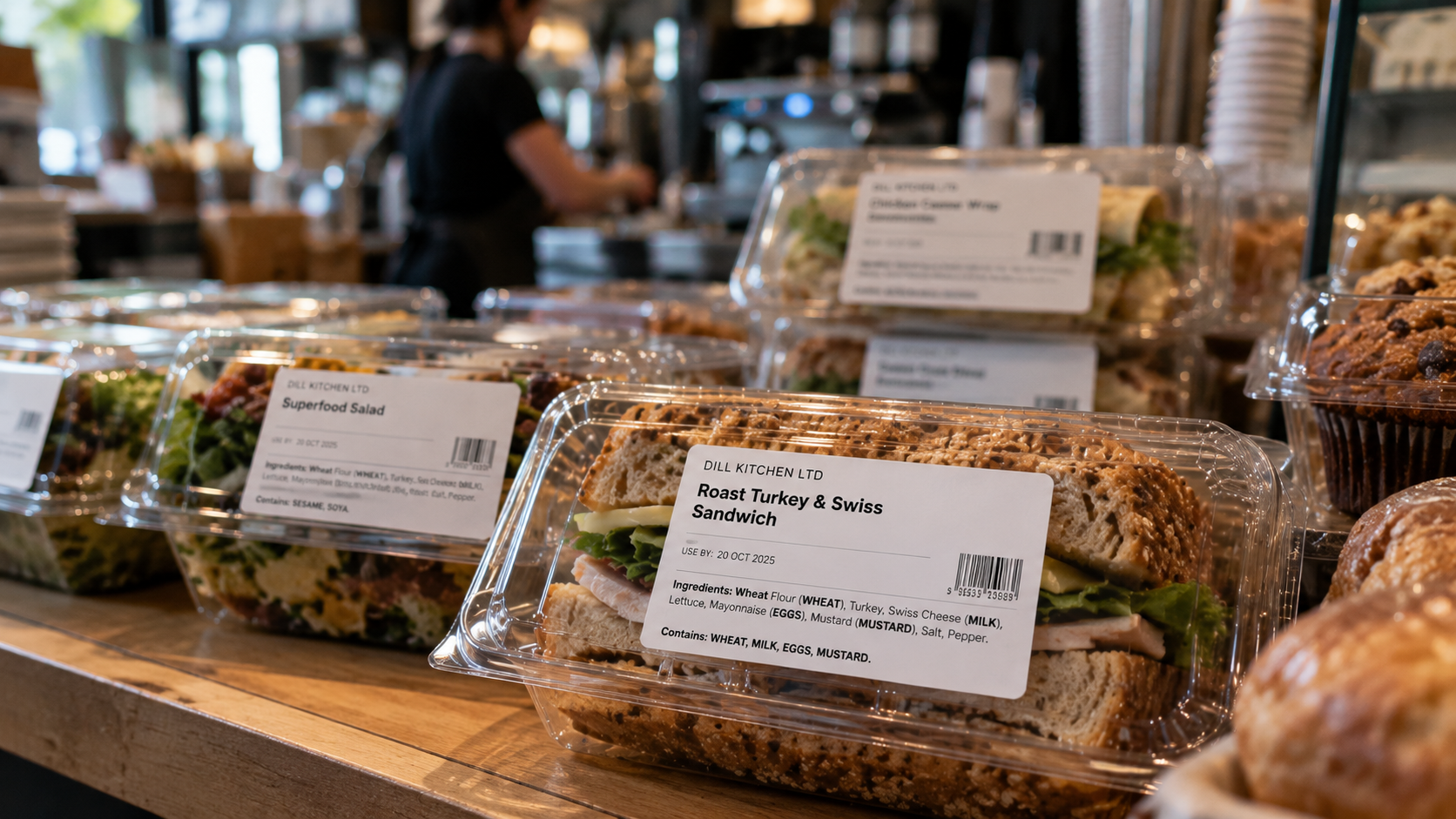
It's 6am in a Toronto deli. One person is wrapping sandwiches, another is boxing muffins from the oven for the grab-and-go case, and someone holding a marker asks the question every morning crew eventually asks: do we write "best before" or "packaged on"? And which way round does the date go?
Canada's Food and Drug Regulations answer most of it. Here it is as one decision path you can hand to a shift lead.
Date labels in Canada in 60 seconds
- Date marking is required on prepackaged food with a durable life of 90 days or less.
- Packed in your store: a "packaged on / empaqueté le" date plus the durable life (on the label or a poster next to the food), or a "best before" date plus storage instructions.
- Packed elsewhere, such as a central kitchen: a "best before / meilleur avant" date, plus storage instructions if it needs conditions that differ from normal room temperature.
- Use the bilingual month codes. If you show the year, it goes first.
- The packaged on date must not go on a bottom label.
- Fresh fruit and vegetables, prepackaged donuts and food packaged frozen need no date.
- Exempt from an ingredient list does not mean exempt from dates. If you show a list anyway, allergen rules apply.
Best before vs packaged on: start with where it was packed
Under FDR section B.01.007(1.1), food with a durable life of 90 days or less that "is packaged on the retail premises from which it is to be sold" must show "the packaging date" and "the durable life of the food, except when the durable life appears on a poster next to the food."
The CFIA's date marking guidance gives retail-packed food two options:
- Option 1: the "packaged on" date plus the durable life, on the label or on a poster next to the food.
- Option 2: a "best before" date plus storage instructions if needed.
The "packaging date" is "the date on which a food is placed for the first time in a package in which it will be offered for sale to a consumer," and also "the date on which a prepackaged product is weighed by a retailer." If your deli weighs and labels at 6am, that's the date.
The 90-day rule and what "durable life" means
Durable life is the period, starting the day the food is packaged for retail sale, during which it keeps "without any appreciable deterioration" its normal wholesomeness, palatability and nutritional value. The durable life date is the day it ends.
The CFIA's retail foods page says foods with an anticipated shelf life over 90 days are "not required to be labelled with date marking information." Voluntary dates still have to follow the prescribed format.
Most deli, bakery and café items are well under 90 days, so set a durable life per product.
Packed in your store vs a central kitchen
The packaged on option only covers food packed on the premises where it's sold. If a central kitchen packs sandwiches for several stores, they're "packaged at a place other than the retail premises," and the label needs:
- the durable life date (best before), and
- storage instructions if the food needs conditions that differ from normal room temperature.
So the same sandwich can need different labels depending on where it was packed. If you run both models, set up two label types.
How to write the date: wording, month codes and order
The regulations prescribe one date marking system, and B.01.007(6) says no one may use any other on the label.
The words. A best before date uses "best before" and "meilleur avant", grouped with the date. A packaging date uses "packaged on" and "empaqueté le".
The month. On consumer packages, the month must be in both English and French, or use the bilingual codes: JA January, FE February, MR March, AL April, MA May, JN June, JL July, AU August, SE September, OC October, NO November, DE December.
The order. The CFIA says the year "is only mandatory when its declaration is needed for the sake of clarity." When you show it:
- the year goes first, using at least the last two digits,
- then the month, in words or the bilingual code,
- then the day, in numbers.
So October 28 is "OC 28" or "October 28 octobre". With the year, it's "26 OC 28": 2026, October, day 28. That's easy to misread, so only add the year when it's needed for clarity.
What about 26/10/28? The CFIA page doesn't discuss numeric dates, but the regulations set out one system, and numbers-only isn't it.
Where the date can go, storage instructions and posters
No-bottom rule. The CFIA, citing B.01.005(1): "The packaging date must not be shown on that part of the label, if any, that is applied to the bottom of the container." Storage instructions can't go there either. A best before date can go on the bottom only if the label says elsewhere where to find it.
Storage instructions. The CFIA says they "are mandatory on foods that require a 'best before' date" where storage differs from room temperature. "Keep refrigerated / Garder réfrigéré" is the standard wording. Under the packaged on option, the regulation lists only the packaging date and durable life. We'd still put "Keep refrigerated / Garder réfrigéré" on chilled deli items as good practice and for food safety, not as a stated legal requirement.
Poster option. You can show the durable life on a poster next to the food instead of on every pack. The CFIA says that poster "may be unilingual" if the label's mandatory information is bilingual.
Two example labels
Both labels are illustrative: the products, ingredients and store are made up. Ingredient lists and "Contains" lines are shown in English only to save space. On a real label they must also appear in French (Ingrédients / Contient).
Example A: turkey and Swiss sandwich, assembled and packed at the deli counter.
Turkey & Swiss Sandwich / Sandwich à la dinde et au fromage suisse
285 g
Packaged on / empaqueté le: OC 26
Best before / meilleur avant: OC 28
Keep refrigerated / Garder réfrigéré
Ingredients: bread (wheat), turkey, Swiss cheese (milk), mayonnaise (egg), mustard, lettuce
Contains: wheat, milk, egg, mustard
CA$9.49
[Store name and address]
Showing both dates together is common practice, and this label meets Option 2 on its own: a best before date plus storage instructions. The packaged on date sits on the lid, not a base sticker. Instead of the best before date, you could print "Best if consumed within 2 days after the packaging date appearing on the label" in English and French, or put it on a poster by the case.
Example B: in-store baked blueberry muffins, 4-pack, packaged on plus poster.
Blueberry Muffins / Muffins aux bleuets
4 x 100 g (400 g)
Packaged on / empaqueté le: 26 OC 27
Ingredients: flour (wheat), blueberries, sugar, eggs, butter (milk), canola oil
Contains: wheat, eggs, milk
[Store name and address]
Poster beside the display: Best if consumed within 3 days after the packaging date appearing on the label.
We've shown the year here to illustrate the order: 26 OC 27 is October 27, 2026. For a 3-day product, "OC 27" alone is clearer. CFIA says the year is needed only for clarity, for example when the durable life runs into the next year. A poster showing the durable life may be unilingual, as long as the label's mandatory information is bilingual. Prepackaged donuts are exempt from date marking; muffins are not.
Expiry dates, "use by" and foods that need no date
Expiration dates apply only to foods for special dietary use, infant formula and human milk fortifiers. The CFIA says "it is prohibited to sell any one of these foods after the expiration date declared on the label has passed."
"Use by" / "employez avant" replaces best before only for prepackaged fresh yeast.
No date needed for prepackaged fresh fruits and vegetables (including chopped or shredded), individual portions served by restaurants and airlines, commissary-made individual servings sold from vending machines or mobile canteens, prepackaged donuts, and food that is frozen when packaged. Food thawed at retail without repackaging needs no date, but single-ingredient meat, poultry and fish thawed before sale must say "previously frozen".
The trap: exempt from ingredients is not exempt from dates
The CFIA's ingredients and allergens page exempts products packed on retail premises from bulk from an ingredient list, and "prepackaged from bulk" includes "any product made on the retailer's premises (for example, assembled, baked, transformed)." Food packed at an off-site facility that supplies more than one store doesn't qualify.
But date marking has no "made in store" exemption. Your in-store muffins may not need an ingredient list, but they still need a packaged on date and durable life.
And if an exempt product "voluntarily carries a label with a list of ingredients, the allergen labelling requirements apply." Show a list, and you must declare allergens properly. See our guide to Canada's priority allergens.
Sandwiches are a gray area. The CFIA says a list of ingredients is required on a sandwich, but the same page treats assembled-in-store products as prepackaged from bulk. Our suggestion: show ingredients and allergens on sandwiches, and get them right.
French, Quebec and local food
Mandatory label information must be in English and French, including the date wording. Some foods made at retail may count as "local food" and be unilingual, but only where the other official language is the mother tongue of less than 10% of local residents, and the label's language is the mother tongue of at least 10%. Quebec has additional French-language requirements, so check with the Office québécois de la langue française.
Your in-store date label checklist
- Fresh fruit or veg, a prepackaged donut, or frozen when packed? No date required.
- Durable life over 90 days? No date required (voluntary dates must use the prescribed format).
- Packed somewhere else? Use best before / meilleur avant, plus storage instructions if not stored at room temperature.
- Packed in store? Choose packaged on / empaqueté le plus durable life, or best before plus storage instructions.
- If you use packaged on, put the durable life on the label or a poster next to the food.
- Use the month code or month in both languages, day in numbers, year first only if shown.
- Keep the packaged on date and storage instructions off any bottom label.
- Add "Keep refrigerated / Garder réfrigéré" on chilled items as good practice.
- If you show an ingredient list, declare the priority allergens properly.
What's still unclear
- Storage instructions under packaged on. Not listed for Option 1 in the regulation. We recommend them as good practice.
- Sandwiches. CFIA guidance points both ways on whether an in-store sandwich needs an ingredient list.
How Dill handles it
Dill keeps your recipes, ingredients, allergens and shelf lives in one place. Staff pick the item on a tablet or phone, and the label prints with the right allergens, dates and who made it.
A change made once reaches every site. Dill connects to POS data (Clover, Lightspeed and others), so products aren't retyped; see label printing for Clover POS. It prints prep and rotation, grab-and-go and made-to-order labels, and runs on Brother label printers, with other hardware on request. Hundreds of businesses use Dill, with thousands of sites between them and over 65 million labels printed. We'll be at Grocery Innovations Canada in Toronto, October 26 to 28.
FAQ
Do I need a best before date on food I package in store in Canada?
Not necessarily. Food packed where it's sold can carry a "packaged on / empaqueté le" date plus the durable life instead.
What's the difference between "packaged on" and "best before"?
Packaged on shows when the food was packed; best before shows when its durable life ends.
How do I write the date on a Canadian food label?
Use the bilingual month code (OC for October) or the month in both languages, then the day in numbers: "OC 28". If you show the year, it goes first: "26 OC 28".
Can I put the packaged on date on the bottom of the container?
No. The CFIA says the packaging date must not be on a label applied to the bottom of the container.
Do donuts and muffins need a date?
Prepackaged donuts are exempt from date marking. Muffins are not.
Is it illegal to sell food past its best before date in Canada?
No. The CFIA says it's not illegal, and that best before dates are not indicators of food safety. Expiration dates are different.
If my baked goods don't need an ingredient list, do they still need a date?
Yes. There's no "made in store" exemption from date marking.