
New York's allergen labeling law takes effect on 11/12/2026.
Picture an ops lead with a deli in Brooklyn, two cafes outside Boston and restaurants in California, asking: which allergen rules apply at which store? Each state does something different, and one state's rules quietly expired.
Each rule below was verified against a statute, bill or official page and given a status: in force, enacted but not yet enforced, expired, or uncertain. Last checked 10/26/2026.
Allergen laws by state in 60 seconds
- Federal law (FALCPA, plus the FASTER Act) requires the nine major allergens on packaged food labels, including sesame since 01/01/2023. It does not cover food wrapped after the customer orders.
- State rules come in three kinds: menu or customer notices, staff or manager training, and written labels on food packed before the order.
- New York is the only state in this tracker with a label rule for food packed in store. It starts 11/12/2026.
- California requires allergen disclosure on menus at chains with 20 or more locations, in force since 07/01/2026.
- New York, Massachusetts, Rhode Island and Connecticut require menu notices and staff posters. Massachusetts and Rhode Island also require a trained or knowledgeable manager.
- Illinois requires allergen training for certified managers in Category I restaurants. Virginia has training rules now and a menu notice law that is enacted but not yet enforced.
- Maryland requires a staff poster only. Michigan's rules expired on 12/31/2020.
How state allergen laws sit on top of federal law
Start with the federal floor. The Food Allergen Labeling and Consumer Protection Act (FALCPA) named eight major food allergens. The FASTER Act, signed on 04/23/2021, added sesame as the ninth, effective 01/01/2023. The FDA's food allergies page lists all nine: milk, eggs, fish, crustacean shellfish, tree nuts, peanuts, wheat, soybeans and sesame.
FALCPA also applies to retail and food service businesses that package and label food, but not to food "placed in a wrapper or container" following a customer's order at the point of purchase.
Then there is the FDA Food Code. It is a model, not a law. The FDA says it is "offered for adoption" by state, local, tribal and territorial governments. The 2022 edition added written allergen notification for unpackaged food. The 2026 Food Code is the latest edition and adds a Major Food Allergen Framework to Annex 2. As of the FDA's 12/09/2025 adoption page, 11 state agencies in 7 states had adopted the 2022 edition. A Food Code provision only binds you if your state or local agency has adopted that edition.
State laws stack on top of all this.
Three kinds of state allergen rule
A multi-state operator can hit all three.
- Menu or customer notice. A line on menus or menu boards asking guests to tell staff about allergies, or in California's case, a list of allergens per menu item. New York, Massachusetts, Rhode Island, Connecticut and California are in force. Virginia is enacted, not yet enforced.
- Staff or manager training, plus posters. A certified or designated manager trained in allergen awareness, often with a staff-area poster. Massachusetts, Rhode Island, Illinois and Virginia have training rules. Maryland has a poster only.
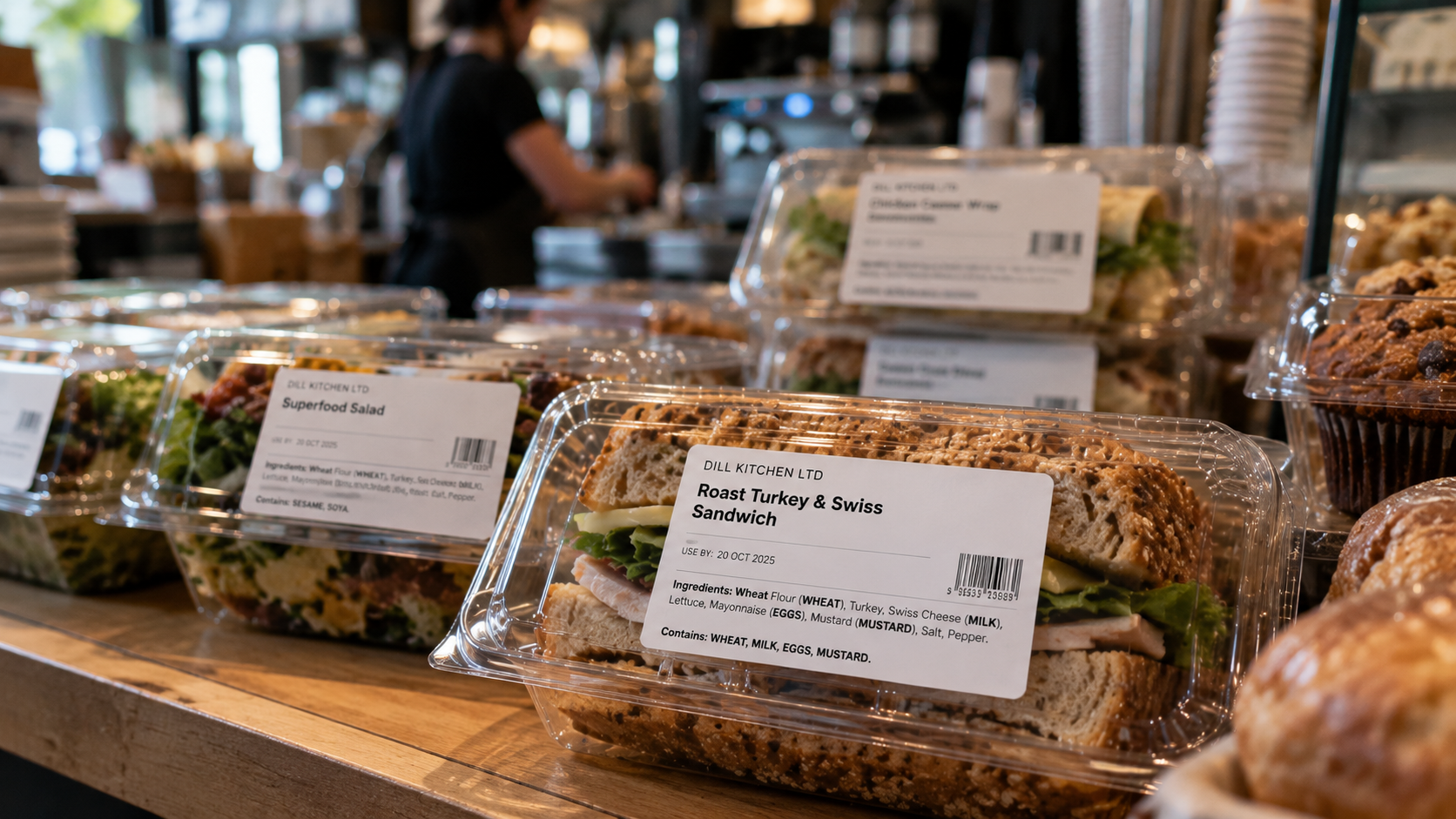
- Written labels on food packed before the order. This matters for delis, bakeries, grab-and-go cases and grocery prepared foods. New York is the only state in this tracker with this rule.
State-by-state tracker
New York
- Requirement: a written allergen notification on prepackaged food, on the package or an attached label, naming any of the nine major allergens in the product. It need not list other ingredients.
- Who it covers: delis, bakeries, sandwich shops, ice cream parlors, cafeterias, food trucks and retail food stores, for food prepacked before the customer orders and sold on the same premises.
- Effective date: 11/12/2026, no phase-in.
- Status: enacted, takes effect 11/12/2026.
- Already in force: Public Health Law 1356 requires a staff allergy notice and an allergy statement on restaurant menus, including online.
- Source: NY Senate bill S5381 (Chapter 494 of 2025).
For covered and not covered examples, penalties and format, see our New York allergen labeling law guide. For a week-by-week plan, use the NY allergen labeling law checklist.
California
- Requirement: written notice of the major allergens the business knows, or reasonably should know, are in each menu item. It can go directly on the menu or in a digital format such as a QR code.
- Who it covers: standard menu items at restaurants and similar retail food establishments in a chain with 20 or more locations under the same name. Excludes compact mobile and nonpermanent food facilities, and items offered for fewer than 90 consecutive days to test customer interest.
- Effective date: 07/01/2026 (SB 68, Chapter 741 of 2025, Health and Safety Code 114093.5).
- Status: in force.
- Source: CDPH SB 68 page.
Massachusetts
- Requirement: a staff-area food allergy poster; a menu notice reading "Before placing your order, please inform your server if a person in your party has a food allergy."; and a person in charge trained in allergen awareness, on site during all operating hours. Certificates are valid for five years.
- Who it covers: establishments that cook, prepare or serve food for immediate consumption.
- Effective date: 2009 per the state health department; updated training guidance from 10/07/2024.
- Status: in force.
- Source: Mass. DPH allergen awareness FAQs and MGL c.140 s.6B.
Rhode Island
- Requirement: a staff-area allergy poster, a menu notice of the customer's obligation to tell the server about allergies, and a designated manager knowledgeable about food allergies.
- Who it covers: food service establishments.
- Effective date: on passage in 2012 (enacted 06/22/2012).
- Status: in force.
- Source: R.I. Gen. Laws 23-20.12-2.
Connecticut
- Requirement: a staff-area allergy poster, with each employee confirming in writing that they reviewed it, and a menu or menu board request that customers notify the server of allergies before ordering.
- Who it covers: Class 2 to 4 food establishments.
- Effective date: poster by 03/01/2024; menus by 01/01/2025 (Public Act 23-115).
- Status: in force.
- Source: CT DPH food establishment resources.
Virginia
- Requirement now: state restaurant regulations must include food allergy awareness and safety training standards (Va. Code 35.1-14).
- Requirement later: a staff notice, plus "If you have a food allergy, please notify us." on each menu or a visible sign. Online menus need the same line and a way for customers to flag an allergy. A separate 2026 law (Chapter 939) directs rules for marking delivery and carry-out food altered for an allergy.
- Who it covers: permitted restaurants.
- Effective date: training rules in force; VDH anticipates the new notice regulations in 2027 and says nothing new will be enforced until then.
- Status: training in force; notice law enacted, not yet enforced.
- Source: VDH food allergy requirements and Va. Code 35.1-14.
Illinois
- Requirement: certified food service sanitation managers must complete allergen awareness training within 30 days of hire and every three years after. Gluten was added to the training topics from 01/01/2026. Keep the certificate on site.
- Who it covers: Category I restaurants. Not grocery or convenience stores, schools, daycares or long-term care. Food handlers without manager certification are not required to take it.
- Effective date: 01/01/2018; amended 01/01/2026 (410 ILCS 625/3.07).
- Status: in force.
- Source: IDPH allergen training FAQ and Public Act 104-0090.
Maryland
- Requirement: a food allergy awareness poster in the staff area.
- Who it covers: food establishments.
- Effective date: 03/01/2014.
- Status: in force. A 2026 restaurant allergen disclosure bill (HB 181) was set for a House hearing on 02/03/2026 and shows no passage.
- Source: Health-General 21-330.2.
Michigan
- Requirement: allergen training for certified food safety managers and a staff poster, both historic.
- Who it covers: food service establishments.
- Effective date: ran until 12/31/2020.
- Status: expired. A 2025 bill (HB 4775) to restore training, a customer notice and a poster shows only introduction and referral to committee.
- Source: MCL 289.2129.
Worked examples
A New York grab-and-go wrap, packed before anyone ordered it and sold in the same store from 11/12/2026:
CHICKEN PESTO WRAP
Contains: Wheat, Milk, Tree Nuts (Pine Nuts)
Packed: 11/12/2026 7:40 AM
Illustrative ingredients: flour tortilla (wheat), pesto with parmesan (milk) and pine nuts (tree nut), chicken, spinach. The law requires a written notice naming the major allergens. "Contains:" is good practice, not required wording. The packed date is optional under the NY law, and naming the specific tree nut follows federal practice rather than the NY text. For more on labeling pre-wrapped items, see our grab-and-go labeling requirements.
A California chain menu line (20 or more locations):
Caesar Salad with Grilled Chicken
Allergens: Milk, Eggs, Fish, Wheat
Illustrative ingredients: parmesan (milk), dressing with egg yolk and anchovy (eggs, fish), croutons (wheat).
Multi-state operator checklist
- List every site by state, and by type: restaurant, cafe, deli counter, bakery, grocery prepared foods, food truck.
- For each New York site, list every product packed before the customer orders. Those need allergen labels from 11/12/2026.
- For each California location, check whether the brand runs 20 or more locations under the same name. If yes, every standard menu item needs its allergens on the menu or a digital menu.
- Put the right menu notice on menus in New York restaurants, Massachusetts, Rhode Island and Connecticut, using each state's wording.
- Confirm a trained person in charge is on site during all hours in Massachusetts, and a designated knowledgeable manager in Rhode Island.
- In Illinois Category I restaurants, check each certified manager's allergen training date: within 30 days of hire, renewed every three years, certificate kept on site.
- Put the right staff poster up in Massachusetts, Rhode Island, Connecticut and Maryland. In Connecticut, collect written employee sign-off.
- In Virginia, keep training current and watch for the 2027 regulations on menu notices and online ordering.
- Keep one allergen record per recipe, and update it before any ingredient swap. Labels, menus and notices should share that data.
What's still unclear
- New York enforcement. Neither new NY section sets its own penalty, and the bill does not say which agency inspects which business. We found no published state guidance as of 10/26/2026.
- Virginia timing. The 2026 notice and delivery marker rules wait on regulations. VDH only anticipates 2027.
- California and grocery delis. CDPH also covers "similar retail food establishments" without defining them. Whether chain grocery prepared-food counters are covered is not confirmed.
- Texas. A 2023 bill (SB 812) appears to have been enacted with a staff poster and training content, but we could not fetch the official statute text. Treat it as uncertain.
- Food Code adoption. Which Food Code edition your state uses was not verifiable from the FDA's table. Check with your state or local health department.
How Dill handles it
Recipes, ingredients, allergens and shelf lives sit in one place. Staff pick the item on a tablet or phone (iOS and Android), and the label prints with the right allergens, dates and who made it. A change made once reaches every site. Dill connects to POS data from Clover, Lightspeed, EposNow, CyBake and PosHub, so products aren't retyped. It prints prep and rotation, grab-and-go and made-to-order labels, and runs on Brother label printers, with other hardware on request. That adds up to hundreds of businesses, thousands of sites between them, and over 65 million labels printed.
Book a demo to see your New York labels before 11/12.
This post is general information, not legal advice.
FAQ
Which states require allergen labels on food packed in store?
Of the states in this tracker, only New York, from 11/12/2026. It covers food prepacked before the customer orders and sold on the same premises.
Is sesame a major allergen everywhere in the US?
Yes, under federal law. The FASTER Act made sesame the ninth major allergen, effective 01/01/2023, and New York's law lists it too.
Does the FDA Food Code apply in my state?
Only if your state or local agency has adopted that edition. The Food Code is a model, and the FDA reported 7 states had adopted the 2022 edition as of 12/09/2025.
Do restaurants have to list allergens on menus?
In California, chains with 20 or more locations must list major allergens per menu item from 07/01/2026. New York, Massachusetts, Rhode Island and Connecticut require a notice asking customers to tell staff about allergies, not a per-item list.
Which states require allergen training?
Massachusetts, Rhode Island, Illinois and Virginia have training or knowledgeable-manager rules. Michigan's training rule expired on 12/31/2020.