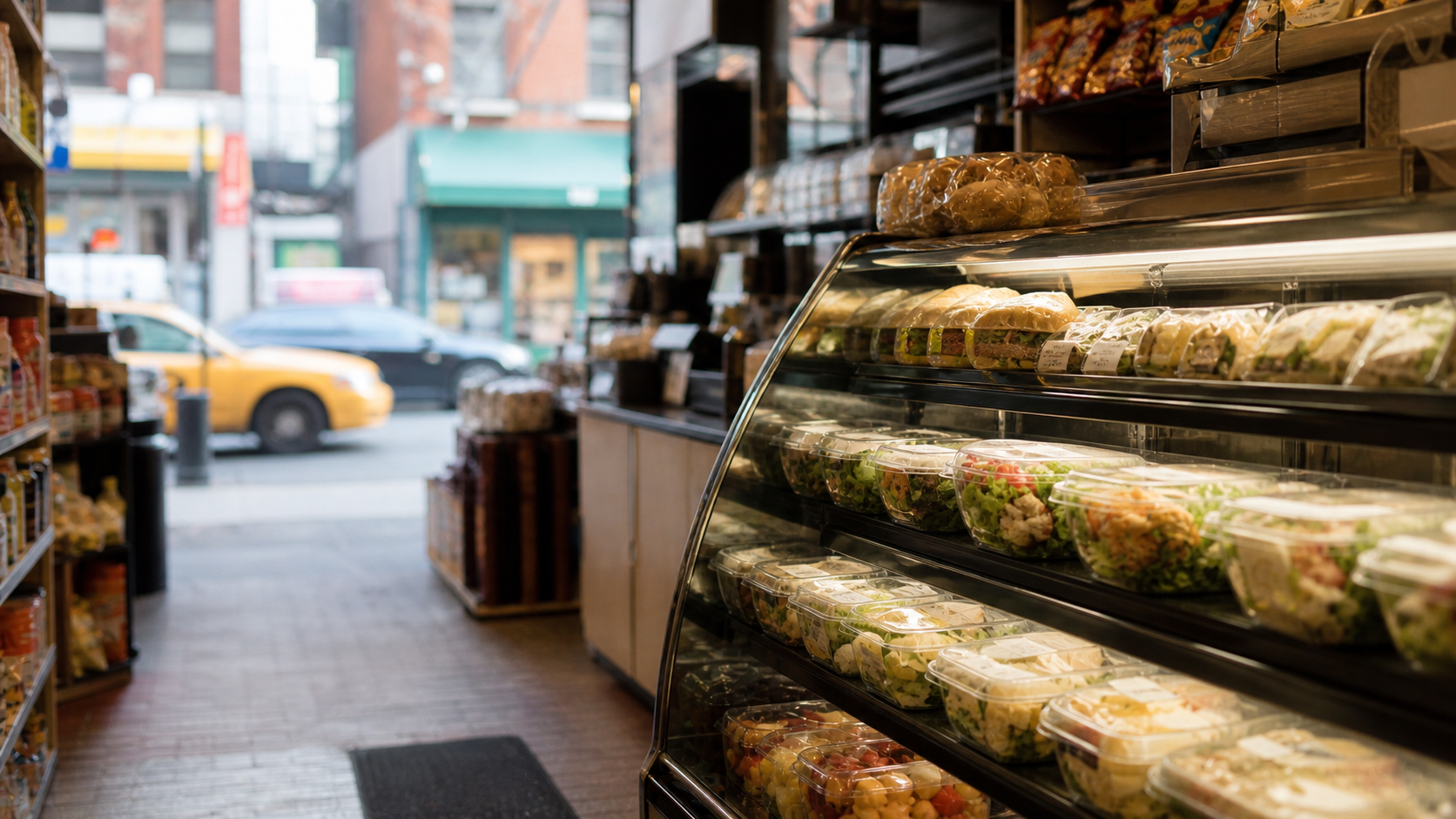

It's 7am in a Toronto grocery deli. The grab-and-go fridge opens at 8, and the team is wrapping turkey sandwiches on sesame buns with Dijon mayo. The new deli manager trained in the US. She knows the 9 major allergens cold, checks the sandwich: wheat, sesame, milk, eggs. Done.
Except it isn't. In Canada, mustard is a priority allergen. So are sulfites, which are in the wine in that Dijon. And if the label carries a "Contains" line, it has to list every one of them, in English and French.
Here's the full Canadian allergen list, why you'll see both 9 and 11, how it compares with the US and UK, and what it means for food you pack in-store.
Canada priority allergens in 60 seconds
- Health Canada lists 11 priority food allergens. Some sources say "9 priority allergens, as well as sulphites and gluten sources." Same rules, counted differently.
- Compared with the US 9, Canada adds mustard, mollusks and sulfites. Compared with the UK 14, it has no celery or lupin.
- Allergens go in the ingredient list or a "Contains" statement. If you use "Contains", it must list every allergen in the food.
- Canada does not allow bold inside the ingredient list. That's the opposite of the UK.
- Most food packaged by a retailer doesn't need an ingredient list. Once you show one, allergens, gluten sources and sulfites must be declared.
- Whether in-store sandwiches and salads are exempt is unclear. Our advice: print the full list plus a Contains statement.
- Mandatory information goes in English and French, unless a narrow local food exemption applies.
The Canadian allergen list: all 11
This is the list as Health Canada publishes it on its food allergies page:
- Eggs
- Milk
- Mustard
- Peanuts
- "Crustaceans and molluscs"
- Fish
- Sesame seeds
- Soy
- "Sulphites"
- Tree Nuts
- "Wheat and triticale"
Health Canada: "Canadian labelling regulations require that the most common food, and food ingredients which can cause life-threatening or severe allergic reactions, are always identified by their common names." For seafood, that means the actual type: CFIA's examples are "tuna" or "halibut", "crab" or "shrimp", "oyster" or "clams".
9 or 11? Why the counts differ
The Food and Drug Regulations split the requirement into three categories:
- Food allergens. Proteins from tree nuts, peanuts, sesame seeds, wheat, triticale, eggs, milk, soybeans, crustaceans, "shellfish (molluscs)", fish and mustard seeds.
- Gluten. Gluten protein from barley, oats, rye, triticale or wheat, including hybridized strains.
- Added sulfites. Declared at 10 parts per million (ppm) or more.
Treat wheat and triticale as one entry, and fish, crustaceans and mollusks as one seafood group, and the food allergens come to 9. Health Canada's consumer list keeps fish separate and adds sulfites, which makes 11.
Gluten is its own category. Barley, oats and rye aren't on the 11-item list, but as gluten sources they still have to be declared.
Canada vs US vs UK
All three cover eggs, milk, peanuts, tree nuts, sesame, soy, fish, crustaceans and wheat.
Canada (11):
- Adds mustard, mollusks and sulfites.
- Names triticale, and requires gluten sources to be declared separately.
- Has regulated sesame and mustard since the 2011 amendments, in force from August 2012.
US (9):
- Sesame was added effective January 1, 2023.
- Crustacean shellfish only. Mollusks are not a major allergen.
- Mustard and sulfites are not major allergens, though sulfites at 10 ppm or more must still be labeled under a separate federal rule.
- No gluten declaration requirement. More on the US side in our guide to the New York allergen labeling law.
UK (14):
- Lists crustaceans and mollusks separately.
- "Cereals containing gluten" covers wheat, rye, barley and oats.
- Includes mustard and "sulphur dioxide and sulphites" above ten parts per million.
- Adds celery and lupin.
A US-trained manager can easily miss mustard, mollusks, sulfites and the non-wheat gluten grains.
How allergens must appear on the label
You can declare an allergen in the ingredient list or in a statement titled "Contains." CFIA's list of ingredients and allergens page sets the rules:
- Contains must be complete. "If a contains statement is used on the label, all allergen, gluten and added sulphite information must appear in the statement at least once."
- Titles are bold. Both "Ingredients:" and "Contains:" (or "Contains" / "Contains :"), and their French equivalents.
- Placement is fixed. Immediately after the ingredient list (or the phenylalanine statement, if there is one), in the same language, with nothing in between.
- No bold inside the ingredient list. The ingredients themselves are in regular type, with no bold, italics or underline. Entries in the Contains statement may be regular or bold.
- Font. A single sans serif font, minimum type height of 1.1 mm, measured on the lowercase x.
Food packed in-store: the exemption and the trap
CFIA's retail foods guidance says "a list of ingredients is not required to appear on the majority of products prepackaged by the retailer, with the exception of mixed nuts and 'seasoned' meat products." CFIA's examples of food packed from bulk in-store include "candies, flour, salt, spices, single ingredient nuts and in store baked breads." Meat and poultry barbecued, roasted or broiled in the store are also exempt.
Now the trap. Under section B.01.010.1(4) of the Food and Drug Regulations, the allergen requirement doesn't apply to those products "unless a list of ingredients is shown on the product's label." The same goes for gluten and added sulfites.
In plain terms: print an ingredient list and every allergen, gluten source and sulfite at 10 ppm or more must be declared.
- Prepackaged or not. Buns a clerk bags ahead of time are prepackaged. Food sold loose and wrapped by a clerk at the customer's request is not.
- Other items still apply. Store name and principal place of business, a durable life date if shelf life is 90 days or less, and net quantity unless an exemption applies.
Sandwiches and salads
Does a sandwich or salad assembled in your deli count as "packaged from bulk on retail premises"? We couldn't find a CFIA statement that says so. CFIA's examples are bulk items and bread, not multi-ingredient prepared food.
So don't assume your grab-and-go sandwiches are exempt. Check with CFIA for your products. Our advice: print the full list plus a Contains statement.
Label example 1: bilingual deli sandwich
The 7am turkey sandwich, packed for the grab-and-go fridge. Ingredients are illustrative.
TURKEY & SWISS ON SESAME / DINDE ET SUISSE SUR PAIN AU SÉSAME
Ingredients: sesame bun (wheat flour, water, sesame seeds, yeast, salt), smoked turkey (turkey, water, salt), Swiss cheese (milk, salt, bacterial culture), Dijon mustard (water, mustard seeds, white wine, vinegar, salt, sulphites), mayonnaise (canola oil, eggs, vinegar, salt), lettuce.
Contains: Wheat, sesame, milk, mustard, eggs, sulphites.
Ingrédients : pain au sésame (farine de blé, eau, graines de sésame, levure, sel), dinde fumée (dinde, eau, sel), fromage suisse (lait, sel, culture bactérienne), moutarde de Dijon (eau, graines de moutarde, vin blanc, vinaigre, sel, sulfites), mayonnaise (huile de canola, œufs, vinaigre, sel), laitue.
Contient : Blé, sésame, lait, moutarde, œufs, sulfites.
220 g · Packaged on / Empaqueté le : 26 OC 06 · Best before / Meilleur avant : 26 OC 08
[Store name], [street address], Toronto ON
Mustard and sulfites both come from the Dijon. Each Contains statement sits directly under its own-language list and repeats allergens already named. That's required, not redundant.
Label example 2: in-store rye bread
Rye bread baked in-store and bagged. It wouldn't need an ingredient list, but this bakery prints one, so the allergen rules apply. Ingredients are illustrative.
RYE BREAD / PAIN DE SEIGLE
Ingredients: wheat flour, water, rye flour, sesame seeds, barley malt, yeast, salt.
Contains: Wheat, rye, barley, sesame.
Ingrédients : farine de blé, eau, farine de seigle, graines de sésame, malt d'orge, levure, sel.
Contient : Blé, seigle, orge, sésame.
680 g · Packaged on / Empaqueté le : 26 OC 06 · Best before / Meilleur avant : 26 OC 09
[Store name], [street address], Toronto ON
Rye and barley aren't on the 11-item list. They're declared because they're gluten sources.
English, French and Quebec
CFIA's bilingual labeling guidance says mandatory information on consumer prepackaged food "must be shown in both official languages, that is, French and English."
For most stores, the exemption to know is "local food." It covers food sold only in the local government unit where it's made or packaged, and adjacent ones, where one official language is the mother tongue of less than 10% of residents. Don't guess your city's numbers: check Statistics Canada census data for your municipality.
Quebec has additional French-language requirements on top of the federal rules.
"May contain" statements
Precautionary statements are voluntary, but CFIA regulates them. Use one only when, "despite all reasonable measures," an allergen may be unintentionally present. They are "not a substitute for good manufacturing practices" and must never cover an allergen you add on purpose. The recommended title is "May contain:". It goes immediately after the Contains statement (or after the ingredient list if there isn't one), with nothing in between, and in both languages if the statements above it are.
Checklist for in-store labels
- Check every recipe against all 11 priority allergens, not the US 9.
- Add gluten sources: barley, oats, rye, triticale and wheat.
- Flag sulfites at 10 ppm or more, including from sub-ingredients like wine and mustard.
- Name fish, crustaceans and mollusks by common name.
- If you print an ingredient list, declare everything.
- For sandwiches, salads and other assembled items, print the full list and a Contains statement unless CFIA confirms otherwise.
- Keep both titles bold, and Contains complete and directly after the list.
- Print mandatory information in English and French unless the local food exemption clearly applies.
What's still unclear
- Assembled grab-and-go food. Whether sandwiches and salads fall under the retail packaging exemption. Ask CFIA.
- Naming tree nuts. Whether "tree nuts" works as a collective name or each nut must be named. Check the prescribed source names in the regulations.
How Dill handles it
Dill keeps your recipes, ingredients, allergens and shelf lives in one place. Staff pick the item on a tablet or phone, and the label prints with the right allergens, dates and who made it. Change a recipe once and it reaches every site, so a new Dijon at one store doesn't leave mustard off the label at another.
It connects to POS data from Clover, Lightspeed, EposNow, CyBake and PosHub, so products aren't retyped. It prints prep and rotation, grab-and-go and made-to-order labels, and runs on Brother label printers, with other hardware on request. Hundreds of businesses use it, thousands of sites between them, with over 65 million labels printed.
See it with your own menu
Bring your deli and bakery items and we'll show you the labels. We'll be at Grocery Innovations Canada in Toronto on Oct 27-28. Book a demo.
FAQ
What are the 11 priority allergens in Canada?
Eggs, milk, mustard, peanuts, "crustaceans and molluscs", fish, sesame seeds, soy, "sulphites", tree nuts, and "wheat and triticale". Gluten sources (barley, oats, rye, triticale, wheat) must also be declared.
Why do some sources say Canada has 9 priority allergens?
The regulations treat food allergens, gluten and added sulfites as separate categories. Count fish, crustaceans and mollusks as one seafood group, and wheat and triticale as one, and the food allergens alone make 9.
Does Canada require allergens to be bolded in the ingredient list?
No. Ingredients must be in regular type. Only the titles ("Ingredients" and "Contains") must be bold, and entries in the Contains statement may be.
Do I need an allergen label on bread baked in my store?
In-store baked bread is one of CFIA's examples of products that don't need an ingredient list. If you show one anyway, allergens, gluten sources and sulfites must be declared.
Is mustard an allergen in Canada?
Yes, it's one of the 11 priority allergens. In the US it is not a major allergen.
Do labels have to be in French?
Mandatory information on consumer prepackaged food must be in English and French, unless a narrow local food exemption applies. Quebec has additional French-language requirements.