It's 6am at the back door of a neighborhood deli. The distributor's driver wheels in a case of romaine, a tub of fresh mozzarella, two sides of salmon and a flat of shell eggs. Someone signs the invoice, and by 7am the mozzarella is sliced, the romaine is chopped and an egg salad is chilling for the grab-and-go case.
All four are on the FDA's Food Traceability List. So what does FSMA 204 ask of that deli? Less than most people fear. For most stores that sell to consumers, the job is to keep good receiving records and write a traceability plan. The slicing, chopping and mixing usually sits outside what you have to record.
For the full rule, including the list of foods and how lot codes work across the supply chain, see our FSMA 204 guide.
FSMA 204 for restaurants in 60 seconds
- If your average annual food sales over the last 3 years are $250,000 or less (inflation adjusted from 2020), the rule doesn't apply to you.
- Above that, you record 8 key data elements (KDEs) when you receive a Food Traceability List (FTL) food. Most of them are already on the invoice and the case label.
- In-store cutting, slicing and mixing of food you sell to consumers usually doesn't need transformation records (21 CFR 1.1350(c)).
- Commissaries and central kitchens that ship food to your stores are different: they keep transformation and shipping records.
- Every covered store needs a written traceability plan and must be able to hand records to FDA within 24 hours of a request.
- The original compliance date was January 20, 2026. The FDA proposed moving it to July 20, 2028, and Congress has barred enforcement before that date.
Does FSMA 204 apply to your restaurant or store?
The rule uses sales size to sort retail food establishments (RFEs) and restaurants. An RFE is a business whose primary function is selling food directly to consumers, meaning its direct-to-consumer sales exceed its sales to everyone else.
Here's the ladder, based on the average annual monetary value of food sold or provided over the previous 3 years, adjusted for inflation with 2020 as the base year:
- Up to $250,000: exempt. Subpart S doesn't apply (21 CFR 1.1305(i)). FDA's own FAQ uses a restaurant averaging about $240,000 as an example of one that's exempt.
- Over $250,000 and up to $1 million: covered, with a lighter load. You keep the records, but you can give FDA another format instead of the electronic sortable spreadsheet (1.1455(c)(3)(iii)(B)). On top of that, an FDA draft enforcement policy from October 8, 2026 says that, if finalized, FDA "does not intend to enforce any of the requirements of the Food Traceability Rule" for this group. The guidance itself is marked "Not for implementation. Contains non-binding recommendations," and comments close 11/23/2026.
- Over $1 million: full requirements, including the sortable spreadsheet on request.
Two details matter. The test counts all food you sell, not just FTL foods. And each franchise location is judged on its own sales, according to the FDA traceability FAQ.
FDA's sources don't state today's inflation-adjusted figures, so check with FDA if you're near a line.
What you actually record: the 8 receiving KDEs
When a covered store receives a traceability lot of an FTL food, 21 CFR 1.1345(a) asks for 8 pieces of information:
- Traceability lot code (TLC). On the case label, assigned by your supplier.
- Quantity and unit of measure. On the invoice or bill of lading.
- Product description. On the invoice and case label.
- Location description of the immediate previous source (not the trucking company). Usually the distributor's name and address on the invoice.
- Location description where you received it. Your address.
- Date received. The date you signed for it.
- TLC source location description or TLC source reference. Who assigned the lot code. Often printed on the case label or passed along by the supplier.
- Reference document type and number. For example, "Invoice 48213" or "BOL 9917."
Your store doesn't assign its own lot code for received food. If a supplier isn't covered by the rule, you record a reduced set of KDEs, and the duty to assign a TLC when none exists doesn't apply to RFEs and restaurants (1.1345(b)(1)).
Paper records are allowed. Keep them for 2 years from creation or receipt (1.1455(d)). A distribution center can hold records for a store, but the store is still responsible for them.
Cutting, slicing, mixing: why in-store prep usually isn't transformation you record
Under the rule, "transformation" means manufacturing, processing or changing a food or its packaging (including commingling, repacking or relabeling) when the result is an FTL food. Chopping romaine for sale could fall under that.
But 21 CFR 1.1350(c) says the transformation record requirements don't apply to RFEs and restaurants for foods they don't ship, "such as foods sold or sent directly to consumers." FDA's FAQ goes further. Restaurants "do not have to link KDEs and TLCs to the recipes or specific foods they prepare," and for food sold to consumers, only receiving KDEs are required, with no shipping records. If you cook an FTL ingredient, like baking soft cheese into an entree, "the restaurant's receiving records are the last records that are required under the rule."
So the deli in our opening scene records 8 KDEs for each lot of romaine, mozzarella, salmon and eggs. The chopped salad, sliced cheese and egg salad it sells over the counter need no further FSMA 204 records.
When you do need transformation and shipping records
The carve-out ends when food leaves your building for another business. FDA's FAQ says a central kitchen that ships to a restaurant "is functioning as a manufacturer/processor, and must keep the transformation KDE records." Shipping records under 1.1340 apply too.
Example: a commissary cuts melon and ships cups to 12 stores. The commissary keeps transformation KDEs, assigns a new TLC to the cups and passes shipping KDEs along. Each store records receiving KDEs for the cups as they arrive.
A store that supplies another business, like a nearby cafe, likely takes on the same records, though that's an inference, not a named FDA example.
Department examples
These follow FDA's FAQ and the Food Traceability List:
- Produce. Receiving KDEs for romaine and tomatoes. Whole-head cabbage isn't a leafy green on the list. Bananas, pineapple, avocado and citrus aren't "tropical tree fruits." A grocer that cuts whole cantaloupe into cups for its own grab-and-go case records receiving KDEs for the whole melons only.
- Deli. Egg salad is itself on the list, but a house egg salad sold over the counter needs only receiving KDEs for the shell eggs. Non-FTL ingredients need no records. Meat salads are excluded from the "RTE deli salads" category.
- Cheese counter. Brie, feta, mozzarella, ricotta and queso fresco are on the list. Cheddar, romano and parmesan are not. Slicing brie at the counter means receiving KDEs only (our reading of 1.1350(c) plus the list, not a named FAQ example).
- Seafood. Salmon arriving from a distributor gets receiving KDEs per lot, taken from the invoice and case label.
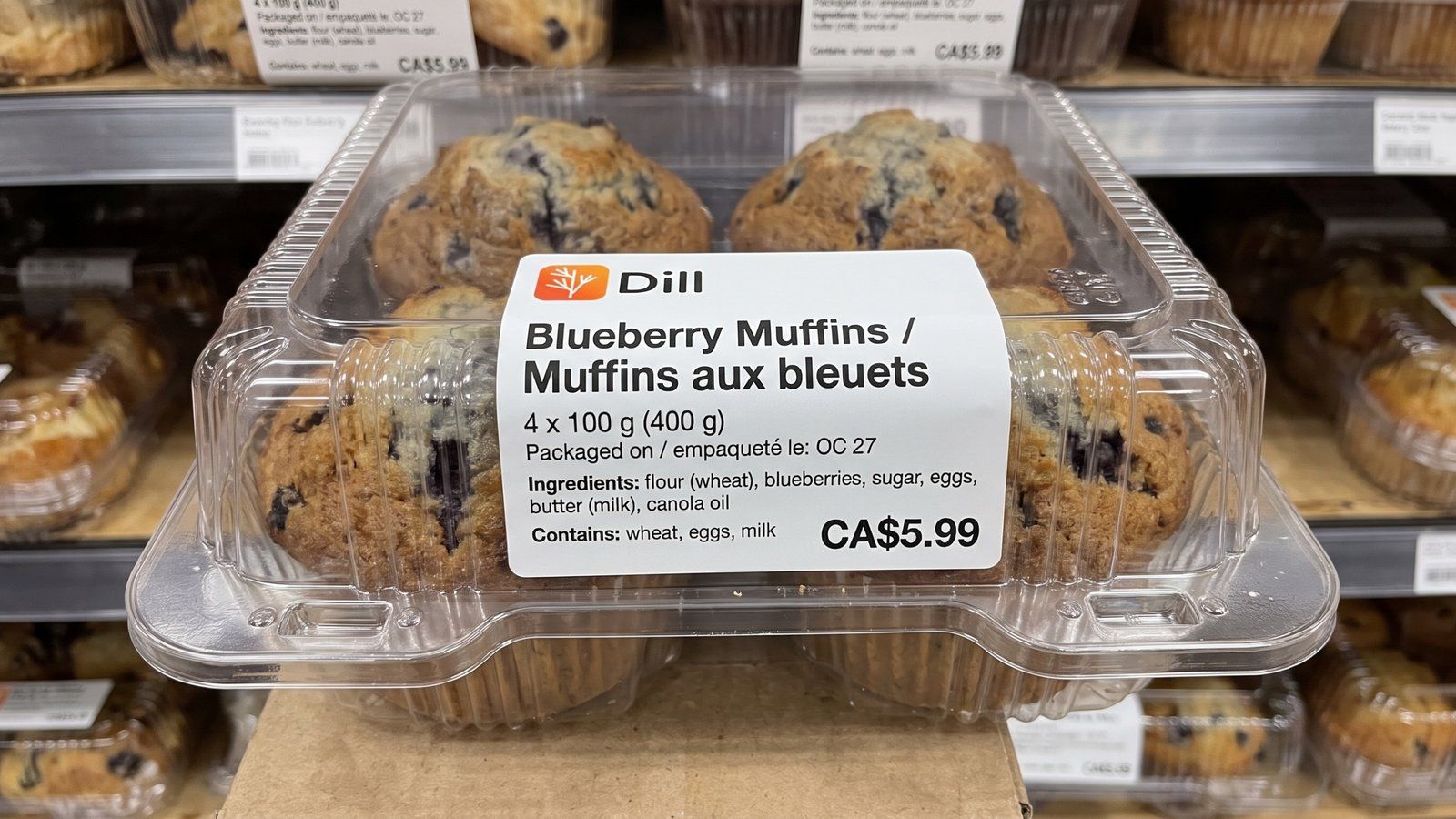
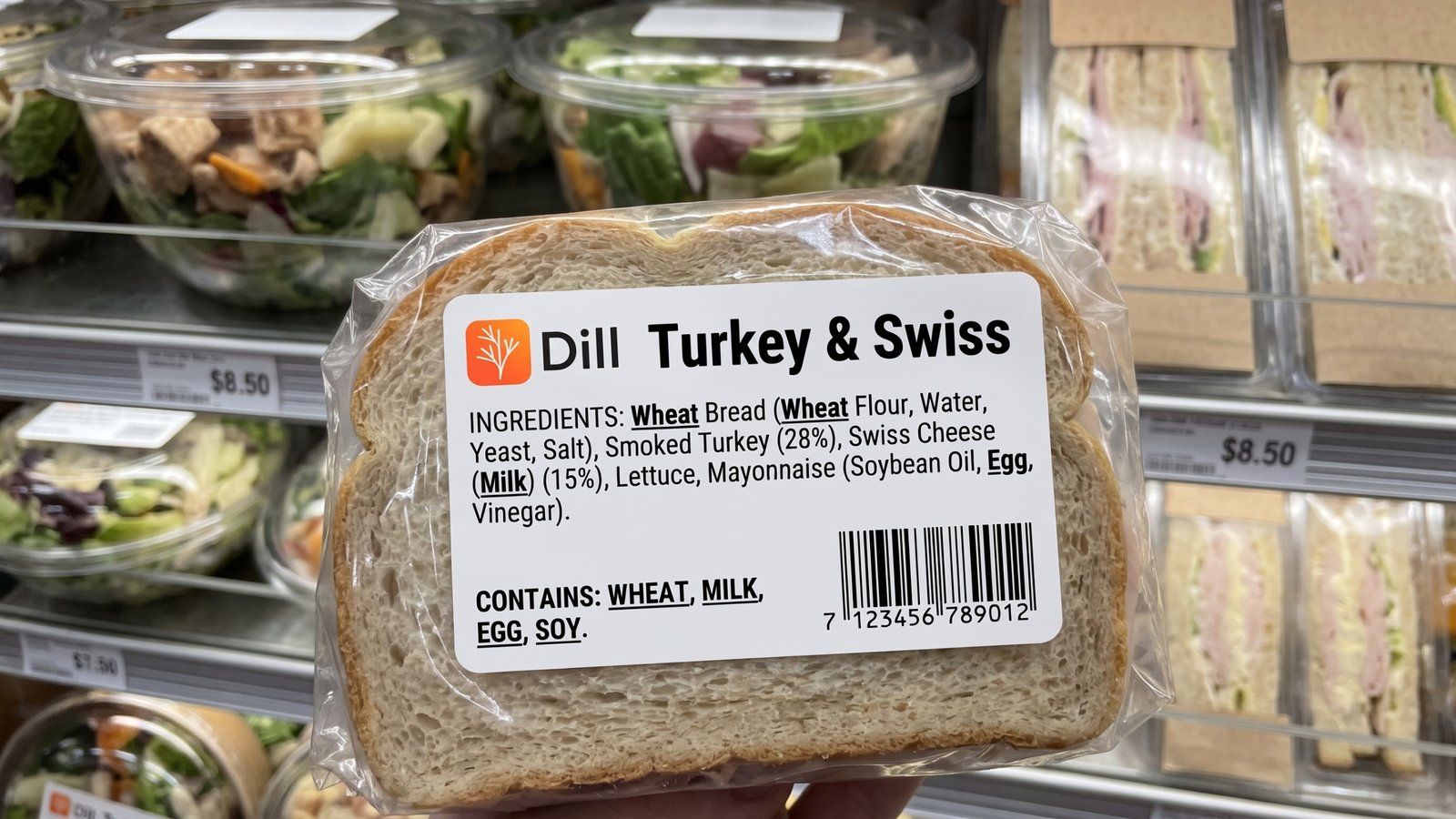
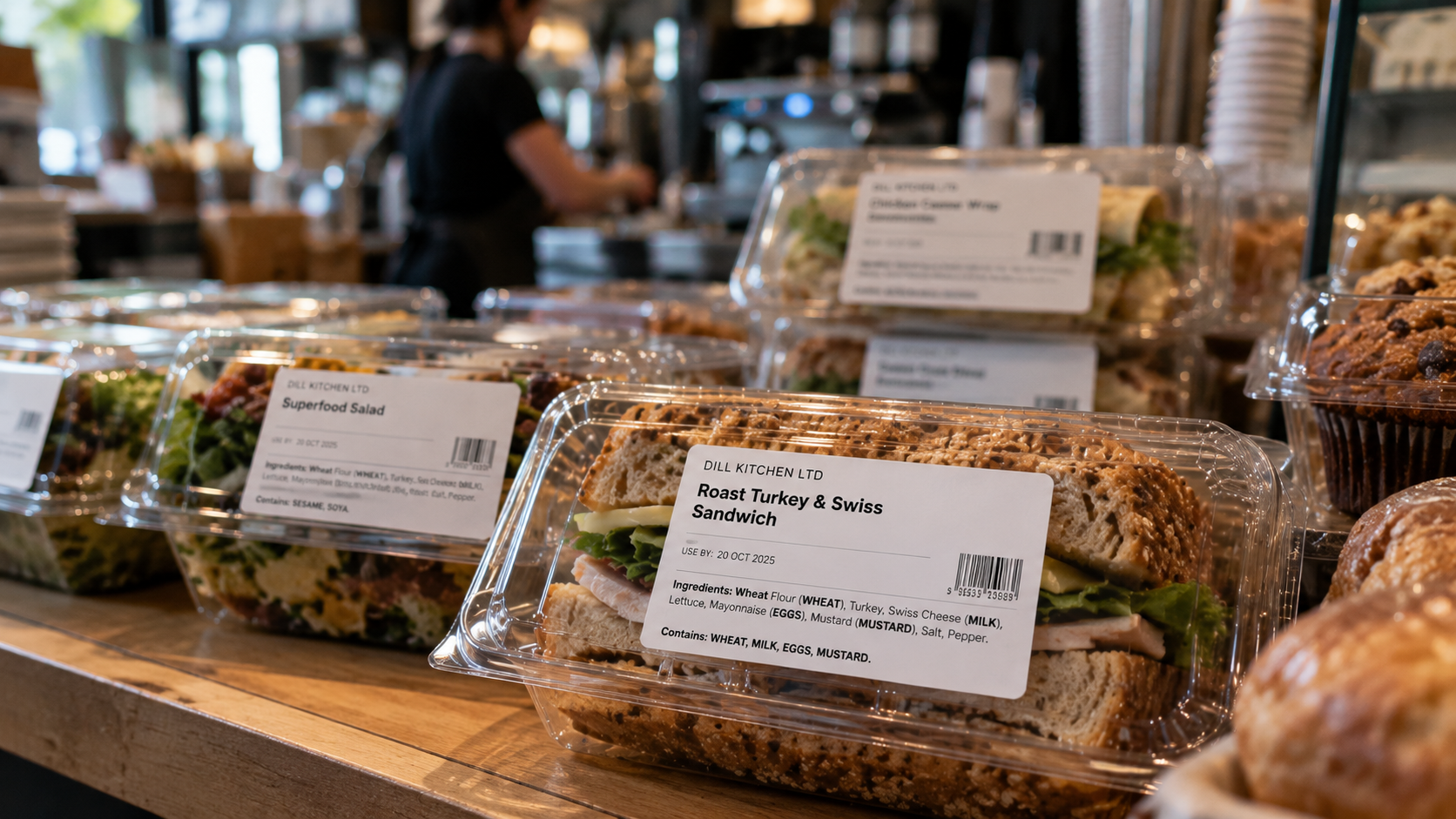
- Grab-and-go. Food made in-store and sold to consumers needs receiving KDEs for its FTL ingredients and nothing more under FSMA 204. Your grab-and-go labeling requirements are a separate question.
Label examples: carrying the lot code forward
None of this is a legal requirement for in-store prep. But when a supplier lot comes back in a recall, a prep label that carries the supplier lot code helps your team find affected product fast. That's good practice, not law.
A 2x2in prep label for fresh-cut melon cups (ingredients illustrative):
CANTALOUPE CUPS
Prep: 11/16 06:30
Use by: 11/18 06:30
By: JM
Supplier lot: CNT-1108-A
A 2x4in grab-and-go label for an egg salad cup (ingredients illustrative):
EGG SALAD CUP
Ingredients: cooked egg, mayonnaise (egg, soybean oil, vinegar), celery, salt, black pepper
Contains: Egg
Made: 11/16
Use by: 11/19
By: AR
Egg lot: EGG-1114-27
Set use-by dates from your own shelf-life rules. The lot code line is there to help answer a trace-back, nothing more.
Farm-direct and ad hoc purchases
Two exemptions come up often in independent restaurants:
- Farm-direct. If a farm produces the food and sells and ships it directly to you, the rule doesn't apply to that food. Keep the farm's name and address for 180 days (1.1305(j)).
- Ad hoc. If you buy from another RFE or restaurant outside your usual purchasing practice, the purchase is exempt for both of you. Keep the product name, purchase date, and seller name and address. A receipt counts (1.1305(k)).
Your traceability plan and the 24-hour request
Every covered store needs a written traceability plan (21 CFR 1.1315). It covers how you keep records (format and location), how you identify FTL foods, how you assign TLCs if you do, and a point of contact. When you update it, keep the previous version for 2 years. A chain can use one plan across locations, held at headquarters, as long as it can be produced within 24 hours.
Under 1.1455(c), you send records to FDA within 24 hours of a request, or within a reasonable time FDA agrees to. A phone request starts the clock. In an outbreak, recall or other threat, FDA can ask for an electronic sortable spreadsheet, unless you're at or under the $1 million line and use another format.
Your receiving checklist
- Work out your 3-year average food sales and where you sit on the ladder.
- List the FTL foods you buy, by department.
- Ask each supplier how they'll show the TLC and TLC source on case labels and invoices.
- Set a receiving routine: whoever signs the invoice confirms the 8 KDEs are there and files it.
- Keep farm-direct records (180 days) and ad hoc receipts separately.
- Flag anything you ship to another business. That needs transformation and shipping records.
- Write your traceability plan and name a point of contact.
- Run a drill: pick a lot and see if you can pull its records within 24 hours.
Where the compliance date really stands
The original compliance date was January 20, 2026. The FDA proposed moving it to July 20, 2028, and Congress has barred enforcement before that date. FDA's rule page says it "intends to comply with this Congressional directive."
That 2028 date rests on a proposed rule plus an appropriations directive, not a final rule.
What's still unclear
- The $250,000 to $1 million non-enforcement policy is a draft. It isn't binding and could change after comments close on 11/23/2026.
- FDA is discussing lot-level flexibilities. Comments on its discussion paper are due 12/06/2026 (Docket FDA-2014-N-0053).
- Store-to-store transfers within a company still have no guidance.
How Dill handles it
Dill doesn't keep your traceability records or produce FDA's spreadsheet. It handles the labeling around them. Recipes, ingredients, allergens and shelf lives sit in one place, and recipes are built from ingredients, so an ingredient change updates every recipe that uses it. Staff pick the item on a tablet or phone (iOS and Android) and the label prints with the right allergens, dates and who made it. A printed label can also carry the lot code and dates your team already has.
A change made once reaches every site, and Dill connects to POS data (Clover, Lightspeed, EposNow, CyBake, PosHub) so products aren't retyped. It prints prep and rotation, grab-and-go, made-to-order and shelf-edge labels, and runs on Brother label printers, with other hardware on request. The numbers so far: hundreds of businesses, thousands of sites between them, and over 65 million labels printed.
Book a demo to see how it works for your stores.
FAQ
Do restaurants have to comply with FSMA 204?
Yes, if average annual food sales over 3 years top $250,000 (inflation adjusted from 2020). At or below that, the rule doesn't apply.
Does chopping lettuce or slicing cheese count as transformation?
It fits the definition, but RFEs and restaurants don't keep transformation records for food sold directly to consumers (21 CFR 1.1350(c)). In general, your receiving records are the last records required.
What records does a grocery store need under FSMA 204?
Receiving KDEs for each lot of FTL food, plus a written traceability plan. Every covered store must establish and maintain one (21 CFR 1.1315).
Do I need the FDA sortable spreadsheet?
Only if your average annual food sales are over $1 million and FDA asks during an outbreak, recall or other threat. At or below that, you can use another format.
Is the FSMA 204 deadline January 20, 2026?
That was the original date. The FDA proposed moving it to July 20, 2028, and Congress has barred enforcement before that date.
Does my commissary need different records?
Yes. A central kitchen that ships to your stores functions as a manufacturer/processor and keeps transformation and shipping records. Your stores record receiving KDEs.