
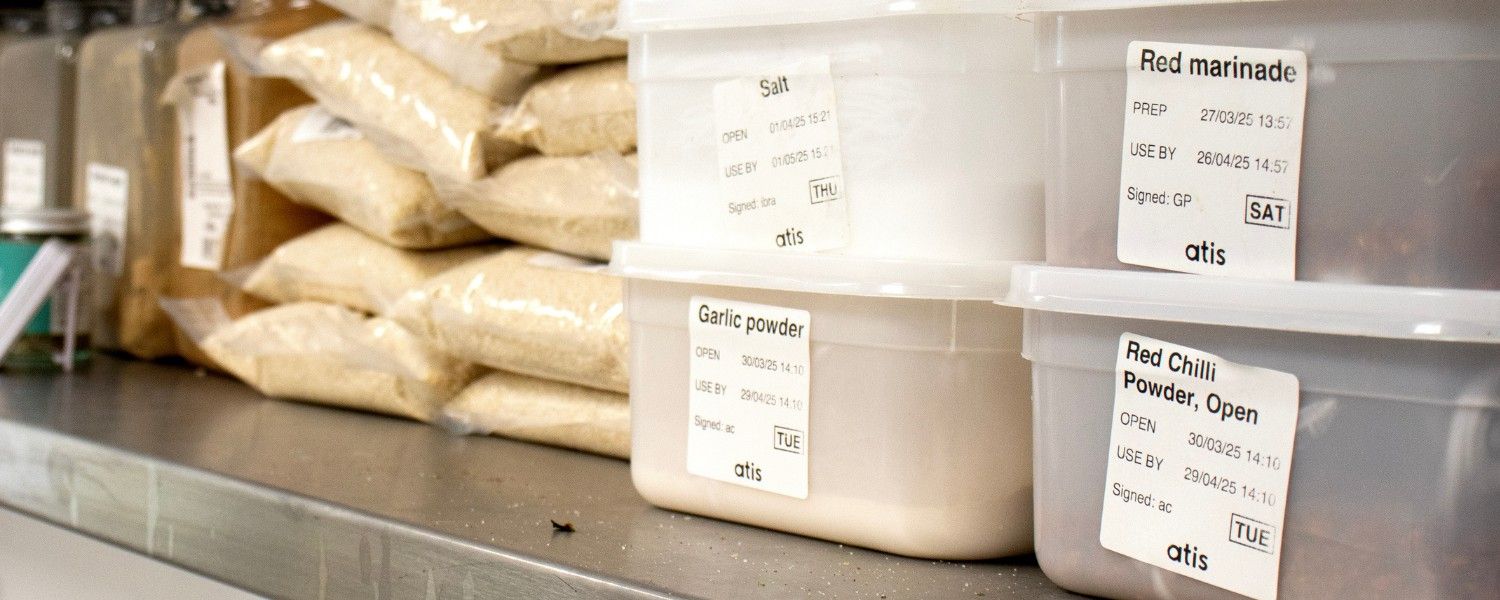
It's Sunday night close. You open the reach-in and there's a quart of tuna salad with a blue dot on the lid. Blue means Monday. But which Monday? This one, six days ago, or last week's, which would make it two weeks old? Nobody wrote anything else on the lid. The person who made it is off until Wednesday.
That's the problem with day dots. They're a cheap, color-coded way to date mark food, and inspectors accept them. They also leave out most of what the closer needs to know.
Here's what day dots are, the common color chart, how they fit the FDA Food Code 7-day rule, how to count the days, and when to move to printed labels.
Day dots in 60 seconds
- Day dots are small color-coded stickers that mark the day an item was prepped or opened.
- The most common chart runs Monday blue, Tuesday yellow, Wednesday red, Thursday brown, Friday green, Saturday orange, Sunday black. It is a convention, not a legal standard.
- The FDA Food Code says refrigerated ready-to-eat, time/temperature control for safety (TCS) food held more than 24 hours must be date marked and used within 7 days at 41°F or below. The prep or opening day is Day 1.
- Color codes are an accepted way to date mark, as long as you can explain the method to your regulator on request.
- FDA inspectors found date marking out of compliance in about a third of fast-food and two-thirds of full-service restaurants.
- A dot shows the prep day. It doesn't show the discard date, the item, who made it, or which week.
- Printed day-dot labels keep the color system and add the rest.
What day dots are
"Day dots" is the generic name for small round stickers, one color per day of the week, stuck on a container to show when the food inside was prepped or opened. Plenty of label suppliers make them, often under their own brand names.
They come in a few common sizes: 1" round, 2" x 2", 2" x 4" and 3" round. The bigger ones usually have space to write the item name and a use-by date. The small round ones are just a color and a day.
The appeal is obvious: they're cheap, fast, and a cook can scan a shelf for colors without reading anything.
The day dot color chart
Here is the most common color scheme:
- Monday: blue
- Tuesday: yellow
- Wednesday: red
- Thursday: brown
- Friday: green
- Saturday: orange
- Sunday: black
Two things to know. There is no legal standard for these colors: the Food Code doesn't assign colors to days. And brands vary. If a new manager reorders from a different supplier, your chart can quietly change. Post your chart by the prep station and stick to one scheme.
Some suppliers also sell day-neutral "universal" labels with no day printed, for kitchens that write the date instead.
Day dots and the FDA 7-day rule
Day dots exist because of date marking. Here's what the FDA Food Code, section 3-501.17 actually says:
- Food prepared in-house. Refrigerated, ready-to-eat TCS food prepared on site and held for more than 24 hours must be clearly marked. It can be kept for a maximum of 7 days at 41°F (5°C) or below. The day of preparation counts as Day 1.
- Commercially processed food you open. For refrigerated, ready-to-eat TCS food from a processor, the day you open the package is Day 1. The date you mark can't go past the manufacturer's use-by date.
- Combined foods. When you mix ingredients with different dates, the new item keeps the date of the earliest-prepared ingredient.
- Marking method. The code is flexible. Calendar dates, days of the week and color codes are all allowed, as long as the method is disclosed to the regulator on request. FDA's date marking guidance names color-coded marks as acceptable.
Section 3-501.18 covers the other side: food must be discarded if it's past 7 days, if it isn't marked, or if it's marked with a date beyond the limit. An unmarked container is a discard, even if you know it was made yesterday.
There are exemptions. Individual meal portions served or repackaged from a bulk container at a customer's request don't need their own mark. Shellstock is exempt. So is a list of commercially processed foods, including deli salads made in a processing plant, certain hard and semi-soft cheeses, cultured dairy products, preserved fish, shelf-stable fermented sausages and salt-cured products.
Law, guidance, or house rule?
The Food Code is a model code, not federal law. States and localities adopt it, and they adopt different editions. As of FDA's 2024 tally, only 7 states had adopted the 2022 edition. The 2026 Food Code was released on September 17, 2026 with no change to the 3-501.17 rule text, but your state may be on an older edition with its own wording. Check which edition your state or county uses.
So: the 7-day limit and marking requirement are law where adopted. FDA guidance explains how to apply them. The color chart is good practice, nothing more.
Why this matters: the compliance numbers
In FDA's Retail Risk Factor Study for 2017-2018, "properly date marked and discarded within 7 days" was out of compliance in 34.61% of fast-food restaurants and 64.11% of full-service restaurants. That's roughly one in three quick-service kitchens and nearly two in three sit-down kitchens.
Retail delis don't do much better. FDA's 2019-2022 deli study found 35.8% out of compliance on the same item.
The usual culprit isn't someone ignoring the rule. It's a container with no mark, or a mark nobody can read.
How to count the 7 days
Counting is where kitchens trip up.
- Day 1 is the day you prep or open it. Not the next day. If you prep tuna salad on Monday 09/28, that's Day 1, and Day 7 is Sunday 10/04. Discard at the end of Sunday.
- Opened packages start on opening day. A commercially made, ready-to-eat TCS item opened Wednesday 09/30 is good through Tuesday 10/06, unless the manufacturer's use-by date comes first. Then the manufacturer's date wins.
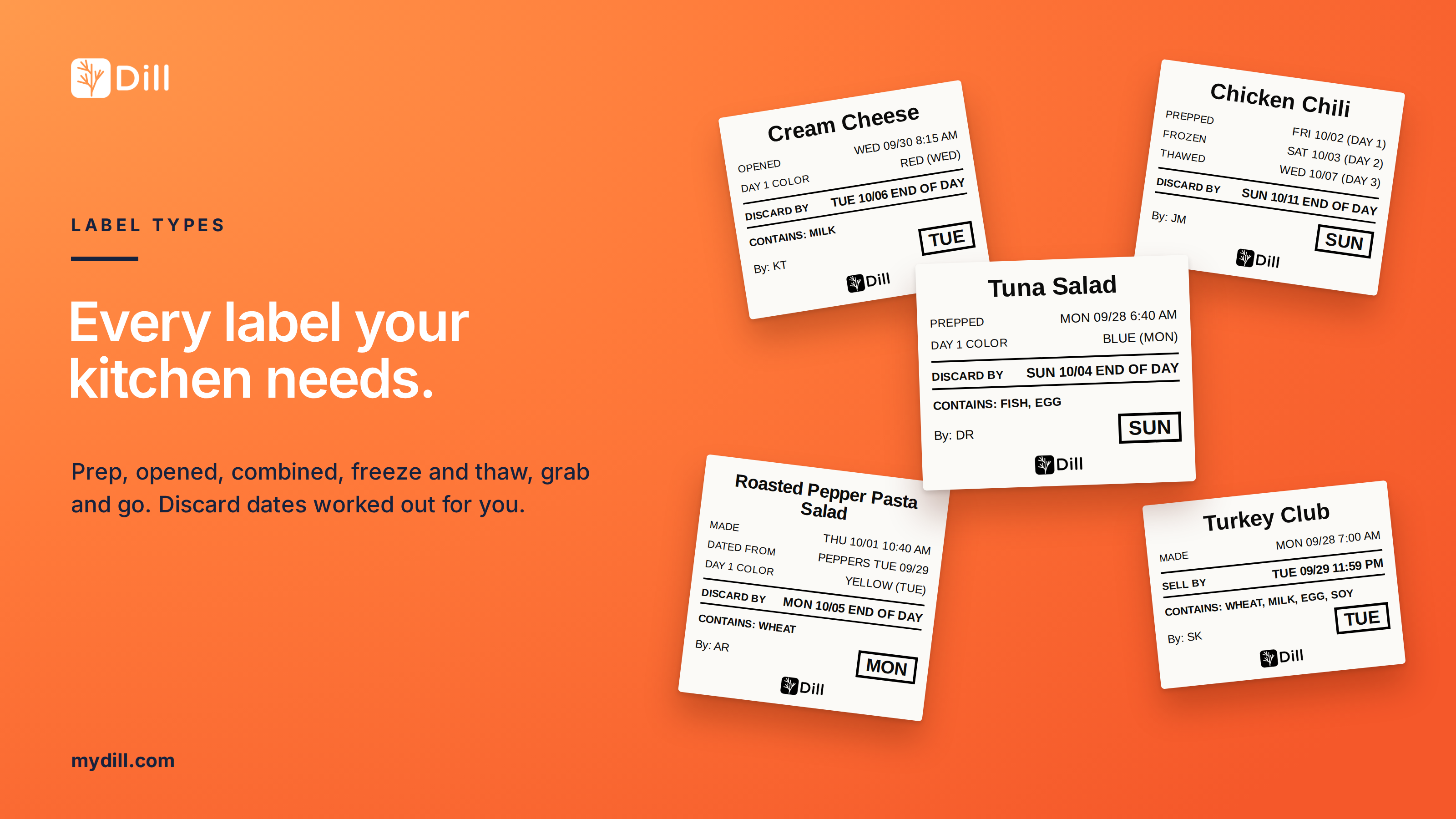
- Combined foods take the earliest date. If you make pasta salad on Thursday 10/01 using roasted peppers prepped Tuesday 09/29, the pasta salad is on the peppers' clock. Day 1 is Tuesday 09/29, and it goes Monday 10/05.
- Freezing pauses the clock. It doesn't reset it. Days used before freezing still count after thawing. If an item used 2 days before it went in the freezer, it has 5 days left once it thaws. Some state guidance goes further: Tennessee's date marking guide says the freeze and thaw dates must go on the container with the prep date.
- Time of day is optional. FDA guidance doesn't require it, but it helps on busy prep days.
- When in doubt, throw it out. Unmarked or over the limit means discard under 3-501.18.
Here's what the combined-food example looks like on a label:
Roasted Pepper Pasta Salad · PREP
Made: THU 10/01 · 10:40 AM
Discard by: MON 10/05 · end of day
By: AR · Contains: Wheat
The right dot here is yellow, for the peppers' Tuesday. Thursday's brown would give it two days it doesn't have.
Dissolvable, removable or permanent
Day dots come in three adhesive types. Pick by what the container is and how you wash it.
- Dissolvable. Dissolves in water. Best for reusable containers going through the dish machine or three-compartment sink, since there's no scraping and no sticky residue.
- Removable. Peels off cleanly by hand. Good for containers that don't get soaked, and for stainless or plastic you don't want gummed up.
- Permanent. Stays put. Use it on disposable containers, bags and wrap, or anything that goes out the door.
Where day dot stickers fall short
- A dot shows the prep day, not the discard date. Every cook has to do the math in their head, on every container, every shift. Counting Day 1 wrong by one is the most common error.
- It doesn't say what the item is. Two white sauces in two deli cups with two yellow dots. Which is ranch and which is garlic aioli?
- It doesn't say who prepped it. When something looks off, you can't ask the right person.
- It doesn't say which week. On Day 7, this week's blue looks exactly like last week's blue. That's the Sunday-night tuna salad from the top of this post.
- It doesn't carry allergens. A dot can't tell front of house that the dressing contains egg.
- Color charts drift. Different brands, a new hire who guessed. Nothing on the sticker says which chart it follows.
The upgrade: printed day-dot labels
A printed rotation label keeps what works about day dots, the at-a-glance color for the day, and adds the details the dot leaves out. The key difference is that the discard date is calculated for you, from the item's shelf life, so nobody has to count on their fingers.
Here's the tuna salad from the reach-in, done properly:
Tuna Salad · PREP
Prepped: MON 09/28 · 6:40 AM · Day 1
Day color: BLUE (MON)
Discard by: SUN 10/04 · end of day
By: DR · Contains: Fish, Egg
Now the Sunday closer knows what it is, that today is its last day, who made it, and its allergens. No guessing which Monday.
If your house rule is shorter than 7 days, the label should say so. The Food Code sets a ceiling, not a target.
A quick date marking checklist
- Mark every refrigerated, ready-to-eat TCS item you'll hold more than 24 hours.
- Count the prep or opening day as Day 1.
- For combined foods, use the earliest ingredient's date.
- Never mark past the manufacturer's use-by.
- Record prep, freeze and thaw dates for anything that goes in the freezer.
- Post one color chart and buy from one supplier's scheme.
- Be ready to explain your marking method to an inspector.
- Discard anything unmarked or past Day 7, at the end of Day 7.
How Dill handles it
Dill keeps your recipes, ingredients, allergens and shelf lives in one place. Staff pick the item on a tablet or phone, and the label prints with the prep date, the discard date and time, who prepped it, and the allergens. Nobody counts days by hand. When you change a recipe or a shelf life once, it reaches every site.
Dill connects to your POS data (Clover, Lightspeed, EposNow, CyBake, PosHub) so you don't retype products. It also prints grab-and-go and made-to-order labels, and runs on Brother label printers, with other hardware on request. Hundreds of businesses, thousands of sites between them, use it for prep labeling and stock rotation.
See it on your own menu
If your reach-in still runs on blue dots and good memory, we'll show you what printed rotation labels look like with your items and shelf lives. Book a demo.
FAQ
What do day dot colors mean?
Each color stands for the day of the week an item was prepped or opened. The most common chart is Monday blue, Tuesday yellow, Wednesday red, Thursday brown, Friday green, Saturday orange and Sunday black, but brands vary.
Is there a legal standard for day dot colors?
No. The FDA Food Code allows color codes as a date marking method but doesn't assign colors to days. You must be able to show your regulator your method on request.
Is the day of prep Day 1 or Day 0?
Day 1. The Food Code counts the day of preparation, or the day a commercial package is opened, as Day 1. Tuna salad prepped Monday 09/28 is discarded at the end of Sunday 10/04.
Does freezing reset the 7-day clock?
No. Freezing pauses the clock but doesn't reset it. Days used before freezing still count after the item thaws, so record the prep, freeze and thaw dates.
What date goes on food made from several prepped ingredients?
The date of the earliest-prepared ingredient. If one component was made two days earlier, the finished item starts on that component's Day 1.
Should I use dissolvable or removable day dots?
Dissolvable dots suit reusable containers that go through the dish machine or sink. Removable dots suit containers you don't soak. Permanent dots are for disposable packaging.
Do I need a day dot printer?
Not by law. Stickers are acceptable. A label printer earns its place when you want the discard date calculated for you and the item, allergens and preparer on every container.