It's 6:40 a.m. at a burger and chicken QSR. The opener pulls a pan of grilled chicken from the walk-in and checks the label before it hits the prep table. Someone is slicing tomatoes. By 11:15 those tomatoes are out on the make line, and by 11:30 the first drive-thru bag of the lunch rush is going out the window.
Each moment has a label. Some are law, some are good practice. This guide maps each QSR label to its rule, and to who prints it and when.
QSR labels in 60 seconds
- Prep and rotation (law): ready-to-eat TCS food held over 24 hours gets a date. Max 7 days at 41°F, prep day is day 1, combined items keep the earliest date.
- TPHC (law, if you use it): food out of temperature control is marked with a time 4 hours later, then served or discarded.
- Thawing (good practice): the code sets thaw methods, not thaw labels.
- Made-to-order and bag labels (good practice): no law requires them for food wrapped to order.
- Grab-and-go (law): food packed ahead for sale needs labeling for the 9 major allergens. New York's own law starts on 11/12/2026.
- Chains with 20+ locations (law): calories on menus, and in California, written allergen information since 07/01/2026.
Where the rules come from
The FDA Food Code is a model code that states adopt, often an older edition, sometimes with edits. The version your state or county adopted is the one that binds you. Quotes below are the Food Code text as adopted by Washington State, which keeps FDA's section numbers, so your wording may differ. FDA's 2026 edition lists no change to the date-marking, discard or TPHC code text.
Prep and rotation labels: the 7-day rule
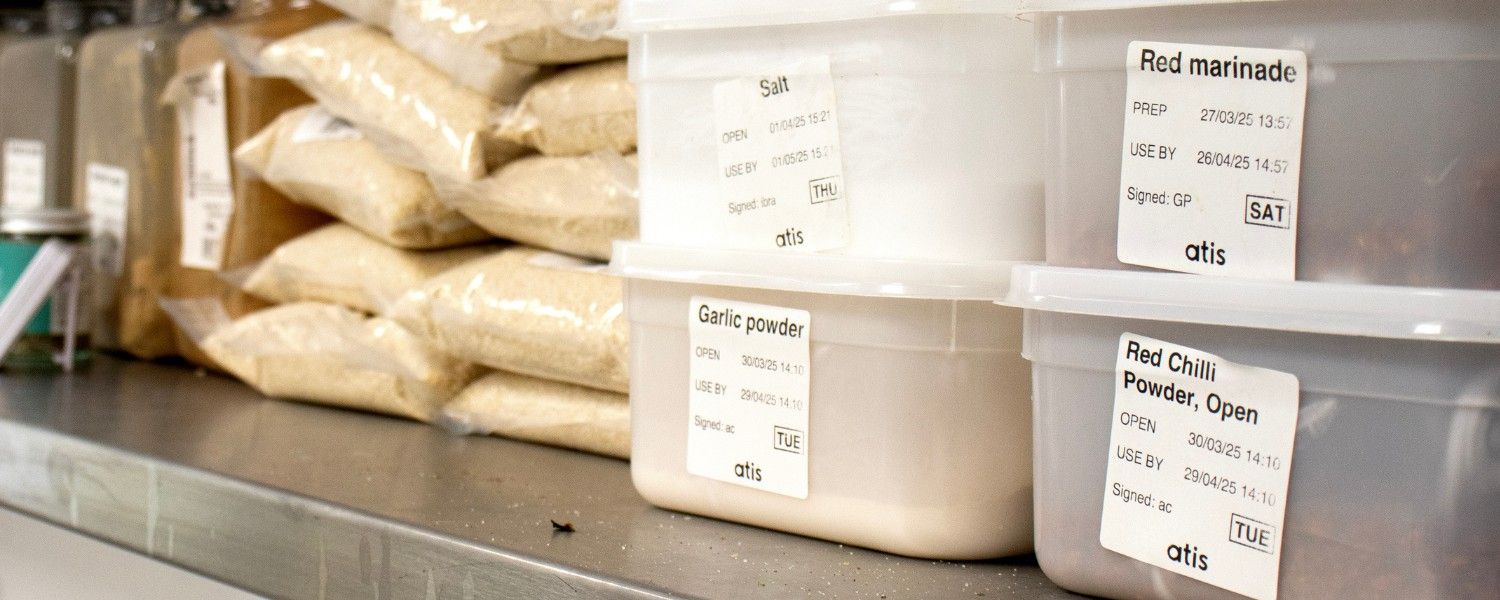
Under Food Code 3-501.17, ready-to-eat time/temperature control for safety (TCS) food "prepared and held in a food establishment for more than twenty-four hours must be clearly marked," and can be held "at a temperature of 41°F (5°C) or less for a maximum of seven days" (Food Code text as adopted by Washington State).
- Day 1 is prep day. "The day of preparation must be counted as day one."
- Combined items keep the earliest date. A mixed item "must retain the date marking of the earliest-prepared or first-prepared ingredient."
- Opened commercial packages count. Opening day is day 1, and the mark can't pass the manufacturer's use-by date.
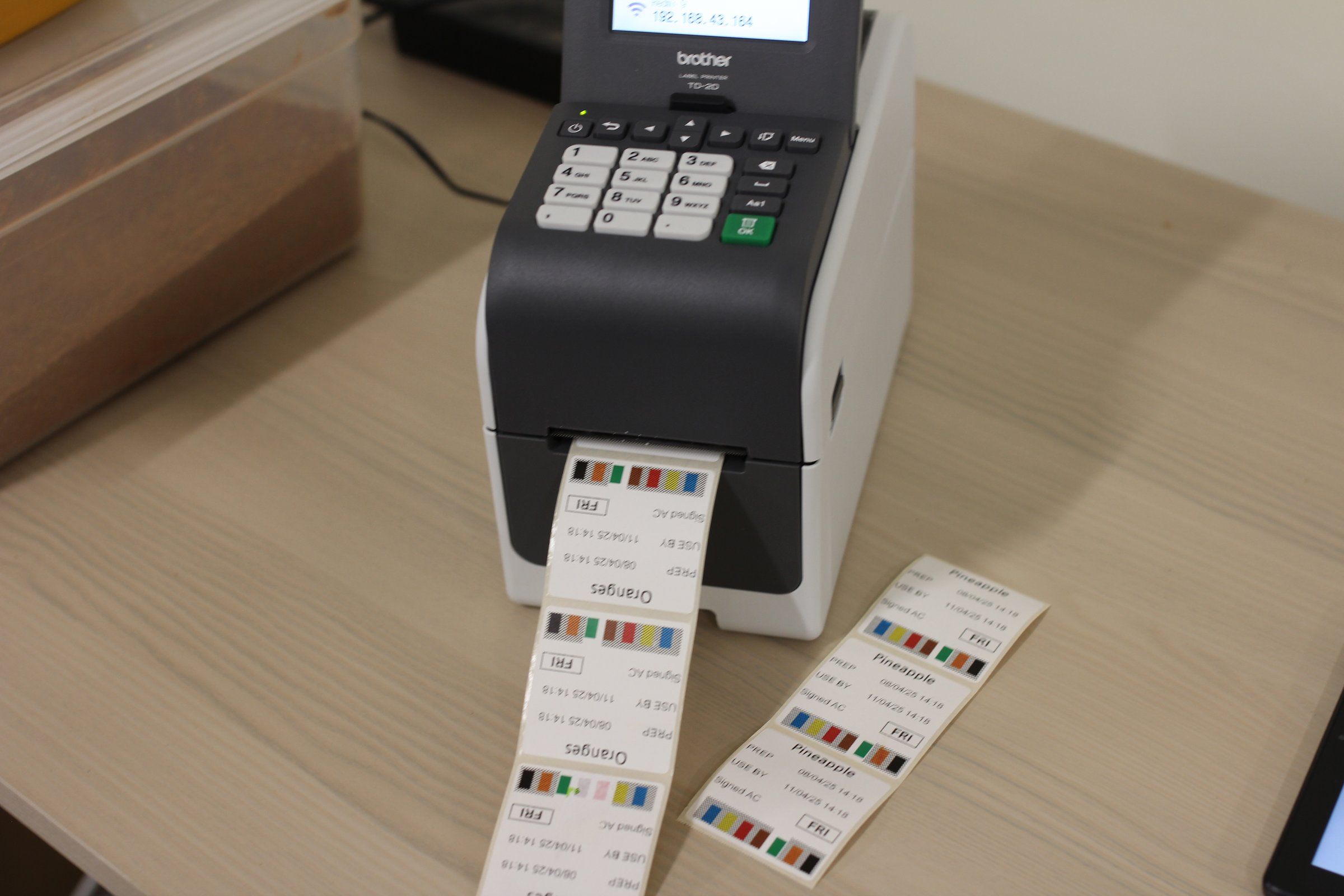
Any effective method works, including "color-coded marks," if you can explain it to your inspector. For dot colors, see our day dots colors and 7-day rule guide.
Under 3-501.18, food is discarded if it's past the limit, undated, or marked beyond the limit. Frozen time doesn't count toward the 7 days.
A combined-item prep label, with the math:
CHICKEN SALAD
Prep: WED 11/11/26
USE BY: SUN 11/15/26 (end of day)
Date from: grilled chicken, made MON 11/09
Keep at 41°F or below
Contains: EGG
By: J.R. Batch 2 of 2
Ingredients (illustrative): grilled chicken, mayonnaise (egg), celery, lemon juice, salt, pepper
Assembled Wednesday 11/11, but the chicken was cooked Monday 11/09, so Monday is day 1 and Sunday 11/15 is day 7. Counting from assembly would give Tuesday 11/17, two days too long. Allergens on a kitchen-only prep label are good practice, not law.
TPHC labels: the 4-hour rule on a busy line
Time as a public health control (TPHC) lets food sit out of temperature control for a limited time, like sliced tomatoes on the make line through a rush.
Food Code 3-501.19 (Food Code text as adopted by Washington State) sets the terms:
- Written procedures, "prepared in advance, maintained in the establishment."
- The food starts at 41°F or below from cold holding, or 135°F or above from hot holding.
- It "must be marked or otherwise identified to indicate the time that is four hours past" leaving temperature control.
- Within 4 hours it's cooked and served, served if ready-to-eat, or discarded.
- Food "in unmarked containers or packages, or marked to exceed a four-hour limit, must be discarded."
TPHC: 4 HOURS
SLICED TOMATOES
Out of temp: 11:15 AM
DISCARD AT: 3:15 PM
Date: MON 11/09/26
Started at 41°F or below
By: M.T. Line 1
Serve or discard by discard time
Out of cold holding at 11:15 AM, so whatever is left at 3:15 PM is discarded.
Thawing labels: good practice, not a code rule
Food Code 3-501.13 approves thawing under refrigeration at 41°F or below, under running water at 70°F or below, in a microwave followed straight away by cooking, or as part of cooking. It says nothing about labeling thawed food.
Label it anyway, so nobody guesses how long that case of breaded chicken has been thawing.
Made-to-order and drive-thru bag labels
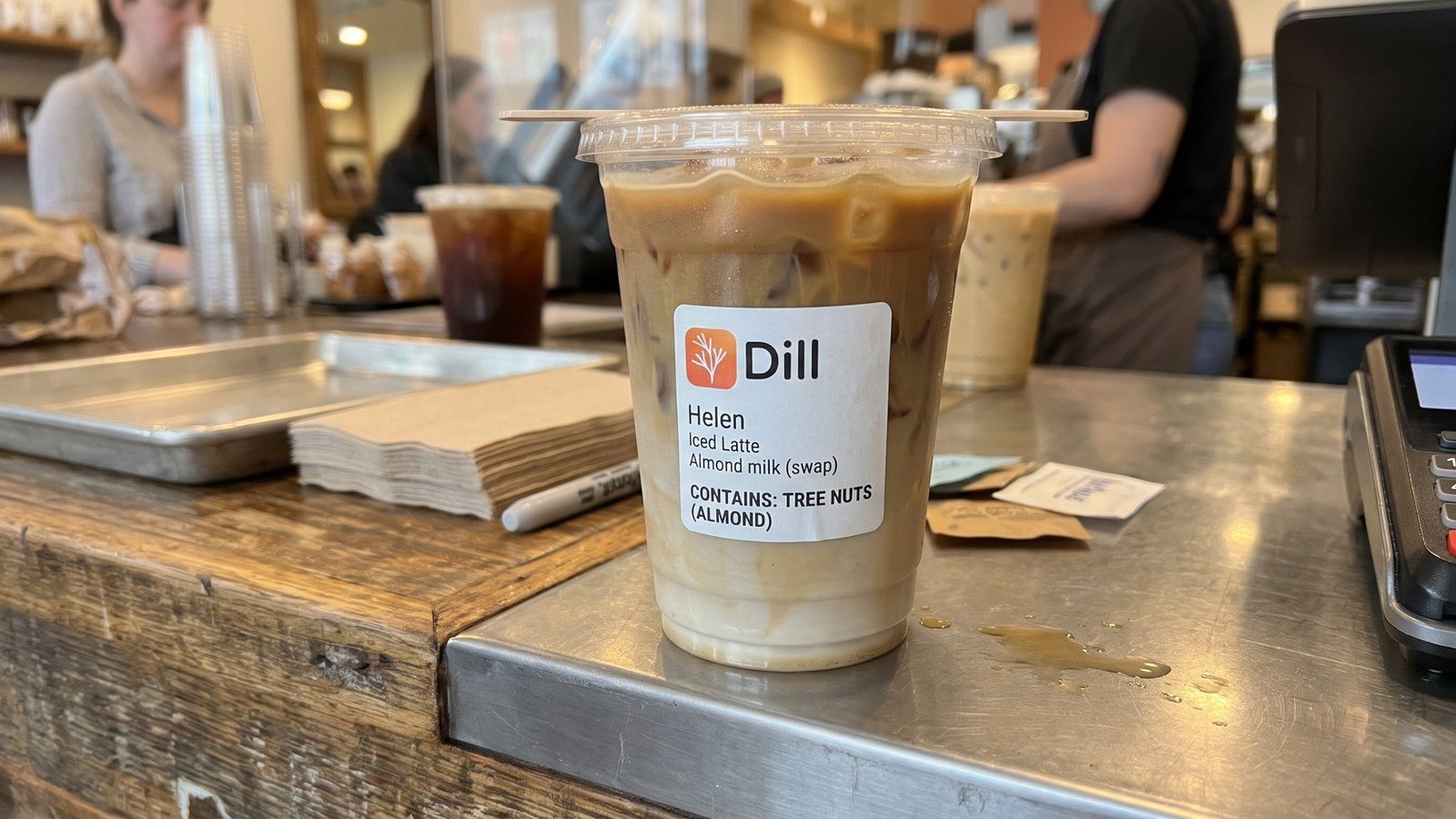
A "no pickles, extra sauce" sticker on a drive-thru bag isn't legally required. FDA's allergen guidance says federal allergen labeling doesn't extend to food "placed in a wrapper or container in response to a consumer's order." Delivery platforms may require bag labels by contract, so check yours.
They still cut remakes. Print them from the order so modifiers come off the ticket, not a marker. Our made-to-order labels guide covers contents and station routing.
Grab-and-go labels: FALCPA, 9 allergens and New York
Grab-and-go, food you pack ahead and sell from a cooler, is different. FDA says federal allergen labeling extends to "foods packaged by a retail or foodservice establishment" that are offered for sale.
FALCPA (2004), plus sesame from 01/01/2023 under the FASTER Act, gives 9 major allergens: milk, eggs, fish, crustacean shellfish, tree nuts, peanuts, wheat, soybeans and sesame.
New York's law starts on 11/12/2026. Under S5381-B, "Every food establishment shall label all prepackaged food with a written notification" on the package or an attached label, for the same 9 allergens. Prepackaged means "prepared, prepacked and offered or sold to customers on the same premises." Food packed after the customer orders is excluded. The bill sets no format, font size or required wording. More on our New York allergen labeling law page.
A New York grab-and-go label for a wrap packed on the first day of the law:
TURKEY & CHEDDAR WRAP
CONTAINS: WHEAT, MILK, EGG
Ingredients (illustrative): flour tortilla (wheat flour, water, salt), sliced turkey, cheddar cheese (milk), lettuce, tomato, mayonnaise (egg)
Net wt 8 oz (227 g)
Packed: THU 11/12/26 Use by: FRI 11/13/26
Keep refrigerated at 41°F or below
Made and packed here: [Store name], [Street], [City], NY [ZIP]
The CONTAINS line is New York's required notice. Ingredients, net weight and business name are recommended, following the Food Code elements for food packaged on site. The one-day use-by is the store's own shelf life, not a regulatory figure.
Chains with 20+ locations: menu calories and California SB 68
For a chain "with 20 or more locations" under one name, selling substantially the same menu items, the menu board is a label too.
Calories (21 CFR 101.11). Calories sit "adjacent to the name or the price" of each standard item, with "2,000 calories a day is used for general nutrition advice, but calorie needs vary" and a note that more nutrition information is available on request. Display and self-service food shows calories per item. Items sold under 60 days a year, daily specials, custom orders and general-use condiments are exempt.
Menu allergens in California (SB 68). Since 07/01/2026, California chains covered by federal menu labeling must give "written notification of major food allergens" for menu items, per the California Department of Public Health. That goes on the menu, or behind a QR code to a digital menu plus an alternative method such as an allergen chart. Items sold under 60 days a year, or under 90 consecutive days as a test, are exempt. Prepackaged food under federal allergen labeling is outside SB 68.
For other states, see our allergen laws by state tracker.
A label plan for each station
Walk-in cooler
- Thaw labels (good practice) and dated TCS batches and opened packages (law).
- The closer or prep lead runs a daily discard pull (law, 3-501.18).
Prep table
- Prep labels printed at batching: item, prep date (day 1), discard date (day 7), preparer, allergens (allergens are good practice here).
- Combined items take the earliest ingredient's date (law).
Line
- TPHC labels when a pan leaves temperature control, with removal time and 4-hour discard time (law, where you use TPHC).
Drive-thru and pack-out
- Made-to-order and bag labels printed from the order (good practice, plus any platform contract).
- Grab-and-go packed ahead gets an allergen label (federal law, plus New York from 11/12/2026).
Menu boards, for chains with 20+ locations
- Calories (21 CFR 101.11), and in California, written allergen information (SB 68).
- The franchisor usually sets these centrally.
Keeping labels consistent across franchise units
Chains with 20+ locations face calorie labeling and, in California, SB 68, and a menu change can leave 40 kitchens printing old labels.
The fix is one source of truth. Recipes, allergens and shelf lives are set by the brand team, and every unit prints from them. Swap in a sauce that contains egg, and every store's next label is right.
- Lock shelf lives and allergen data at brand level. Units choose what they print, not what's on the label.
- Use one label layout everywhere.
- Check each unit's local Food Code adoption. Multi-state franchises may face different editions.
QSR label checklist
- Date-mark ready-to-eat TCS food held over 24 hours: day 1 is prep day, 7 days max at 41°F.
- Give combined items the earliest ingredient's date, and date opened packages on opening.
- Keep written TPHC procedures on site before using time instead of temperature.
- Mark every TPHC pan with removal time and 4-hour discard time.
- Label thawing items with start date, time and method.
- Print made-to-order and bag labels from the order.
- Put an allergen notice on every grab-and-go item packed ahead, including in New York from 11/12/2026.
- With 20+ locations, check menu calories, and California allergen information.
- Run a daily discard pull.
What's still unclear
- Which Food Code edition applies. Ask your local health department.
- Longer TPHC cold holding. Some codes allow a longer cold-held option.
- TPHC approval. Some jurisdictions want prior approval or notification on top of written procedures.
- When a thawed item's clock starts. The code doesn't say whether day 1 is thaw start or thaw end for commercially frozen ready-to-eat food.
- New York enforcement. The law names no inspecting agency, guidance or penalty, and how it interacts with NYC's own health code is unclear. Whether New York grab-and-go needs the full Food Code label elements is unverified.
- Calories on chain grab-and-go. Whether an item with a visible Nutrition Facts panel also needs a calorie sign isn't settled in our research.
- SB 68 at the drive-thru. CDPH doesn't address drive-thru boards or delivery menus.
How Dill handles it
Dill keeps recipes, ingredients, allergens and shelf lives in one place. Recipes are built from ingredients, so one ingredient change updates every recipe using it. Crew pick the item on a tablet or phone (iOS and Android), and the label prints with the right allergens, dates and who made it. Dill prints prep and rotation, grab-and-go, made-to-order and shelf-edge labels, and connects to your POS data so products aren't retyped. A change made once reaches every site. It runs on Brother label printers, with other hardware on request. The numbers so far: hundreds of businesses, thousands of sites between them, and over 65 million labels printed.
Book a demo to see it set up for your kitchen.
FAQ
Do QSRs have to date mark everything?
No. Food Code date marking applies to ready-to-eat TCS food held over 24 hours.
When does TPHC make sense?
For items that sit out on a busy line. You need written procedures on site and a 4-hour discard time on every pan.
Do delivery bags need allergen labels?
Not under federal law, since food wrapped to order is exempt. A delivery platform contract may require them.
Does New York's law cover made-to-order sandwiches?
No. It excludes food packaged after a customer orders.
Does SB 68 apply to my franchise?
It applies to California locations of chains with 20 or more locations covered by federal menu labeling, since 07/01/2026.
Did the 2026 Food Code change date marking?
FDA's summary of changes lists no change to the date-marking, discard or TPHC code text. Your state's adopted edition is what applies.
Can I use day dots instead of printed labels?
For date marking, yes. The code allows color-coded marks if you can explain the method to your inspector.
This guide is general information, not legal advice. Check with your state and local health department for the rules that apply to you.