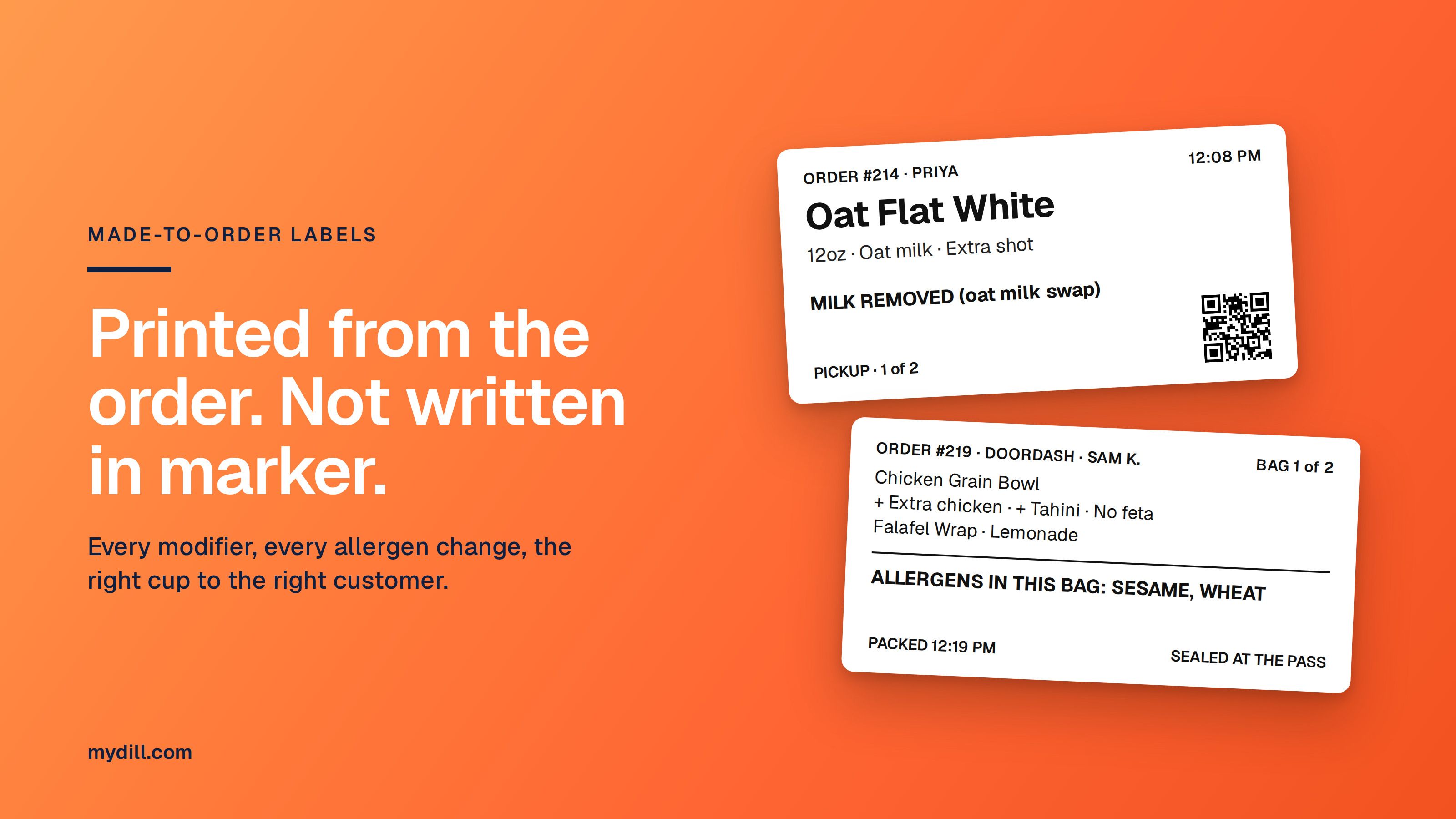
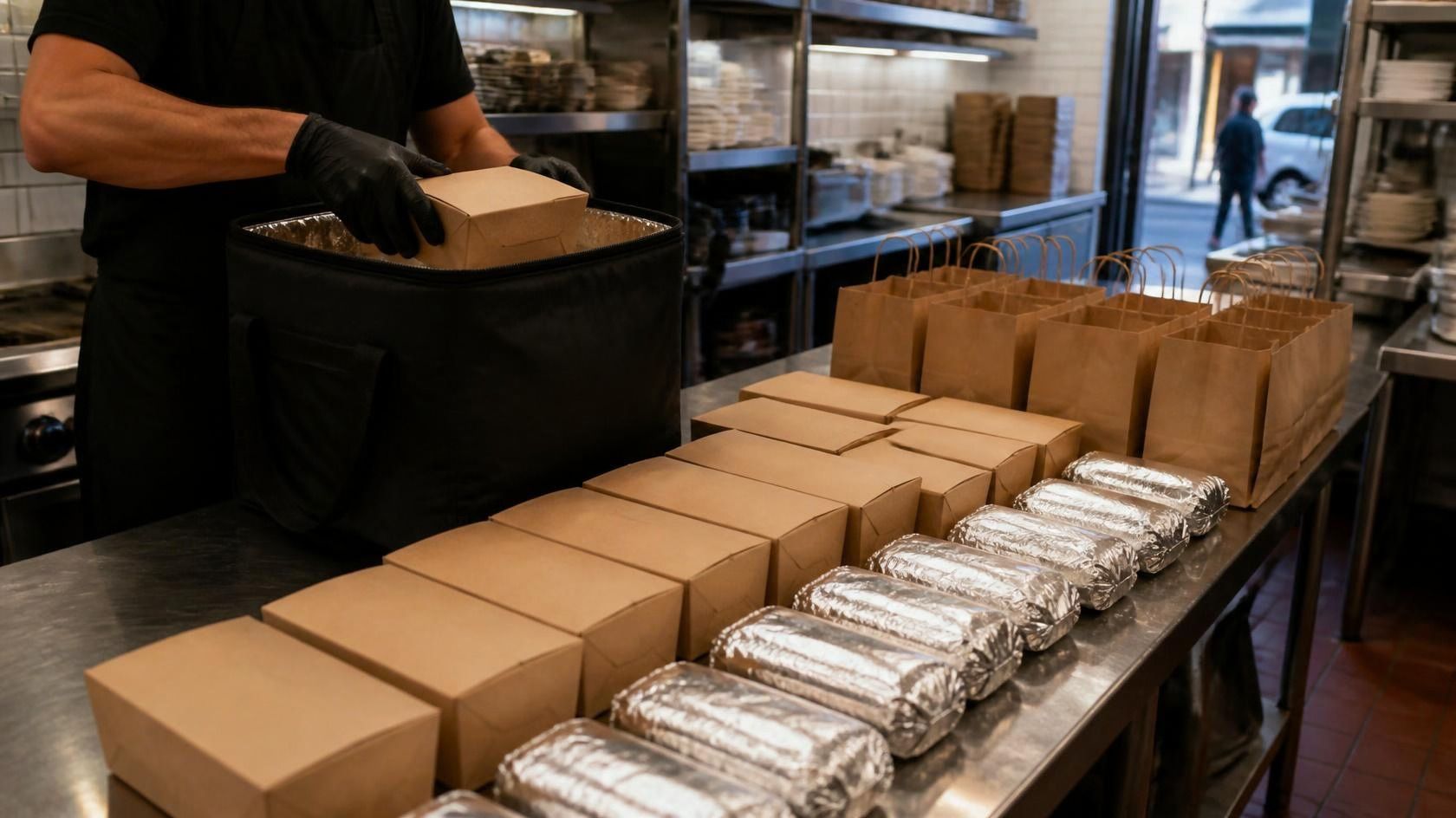
It's 11:20. The driver is coming at 11:45. On the pass there are 40 individually boxed lunches for an office across town, a mix of chicken, salmon and two vegan boxes, plus three shared platters and a tray of cookies.
One of the 40 is for Priya. She has a sesame allergy, and she put it in the order notes.
The catering platform sent a label file this morning. Someone printed it on the office printer, cut the sheet with scissors, and is now sticking names on boxes by matching them against a printed order list. The sheet has her name and her dish. It doesn't say sesame anywhere. The hummus platter, which is full of tahini, has no label at all.
Nobody here is careless. They're just doing a data job by hand, at speed, 25 minutes before pickup.
Order labels in 60 seconds
- What they are: one label per meal, printed from the order, showing who it's for, what it is and what's in it.
- Where they go: individual boxes, bags, and shared trays and platters.
- What they show: the dish, the customer's first name, modifiers, allergens and dietary tags, when it was made and who made it.
- The law: in the US and Canada, made-to-order catering and delivery meals generally aren't covered by allergen labeling rules. Labeling them is good practice, and it's what corporate clients and catering platforms ask vendors for.
- The fix: labels that come from the order data and the kitchen's own recipes, checked by a person before they print, with a record of what went out.
What the law actually says
It's worth being precise here, because a lot of advice online blurs it.
Federal (US). The FDA's allergen labeling rules cover packaged food, including food a restaurant packages ahead of time. They do not apply to food "placed in a wrapper or container in response to a consumer's order." That's straight from the FDA's Allergen Labeling Q&A, question D.16. A boxed lunch made for a specific order falls on that side of the line.
New York. The new state allergen labeling law, S5381B, was signed on 11/12/2025 and takes effect a year later. It covers food that is prepared, prepacked and sold on the same premises, and says plainly that prepackaged food "does not include food that is not in packaging or is packaged after a customer has ordered." So it doesn't reach catering or delivery orders. It does reach your grab-and-go fridge. If you run both, our NY allergen labeling law checklist covers the grab-and-go side.
The Food Code. The 2022 FDA Food Code added a provision asking food establishments to tell customers about major food allergens in unpackaged food in writing. The Food Code is a model, not federal law. It only applies where your state has adopted that version.
Canada. Federal allergen labeling applies to prepackaged products (CFIA labeling tool). Food made to order isn't prepackaged, so the federal rules don't reach it, and we found no federal rule specific to delivery allergen information.
So: no law we found requires an allergen sticker on Priya's box. That's the honest answer.
The practical answer is different. Corporate catering platforms promise their clients that every meal arrives individually packaged and labeled, often with the employee's name, the dish and dietary tags. Office managers ordering for 40 people expect it. And the person with the allergy is the one opening the box.
How it's done today
Most kitchens doing group orders are working with one of two setups, and neither one was built for allergens.
The catering platform sends a PDF or a label file. The kitchen downloads it, prints it on whatever printer is nearby, and sticks the labels on by hand. Some platforms say outright that if you can't print, you can handwrite the information instead. The label data comes from the platform, not from your recipes, so if the kitchen swapped a dressing or changed a supplier, the label doesn't know.
The POS or kitchen display prints item stickers. Most POS and kitchen display systems can print a sticker per item with the item name and modifiers, and some add the guest name and pickup time. That's useful for sorting bags. But allergens and ingredients usually aren't on it. Operators have been asking for a way to make allergies stand out because they get lost among the modifiers. "No tahini" looks the same as "extra lemon."
Neither setup keeps a record. If the office manager calls at 2pm to ask what was in the box marked Priya, the answer is in someone's memory, or in the recycling.
What a good order label looks like
A catering label has to work for three people: the packer at 11:20, the driver at 11:45, and the guest at 12:30. That means:
- Customer first name, large, so the packer and the office can sort by it.
- The dish, in plain words.
- Modifiers, especially removals. "No tahini dressing" is the one that matters.
- Allergens, as a clear "Contains" line, worked out from what's actually in the box.
- Dietary tags, like vegan or gluten-free, if your client asked for them.
- Prepared date and who made it, so there's a name to ask if something's off.
- Your business name, so the office knows who to call.
Here's Priya's box:
PRIYA
Lemon Herb Chicken Rice Box
No tahini dressing (sesame) · Sub lemon olive oil
Contains: Milk (yogurt sauce)
Prepared 10/06/2026 · Made by: Dana
Dill Test Kitchen
And the shared mezze platter that used to go out with no label:
Mezze Platter, serves 10
Hummus · Falafel · Pita · Cucumber salad
Contains: Sesame (tahini), Wheat
Prepared 10/06/2026 · Made by: Luis
Dill Test Kitchen
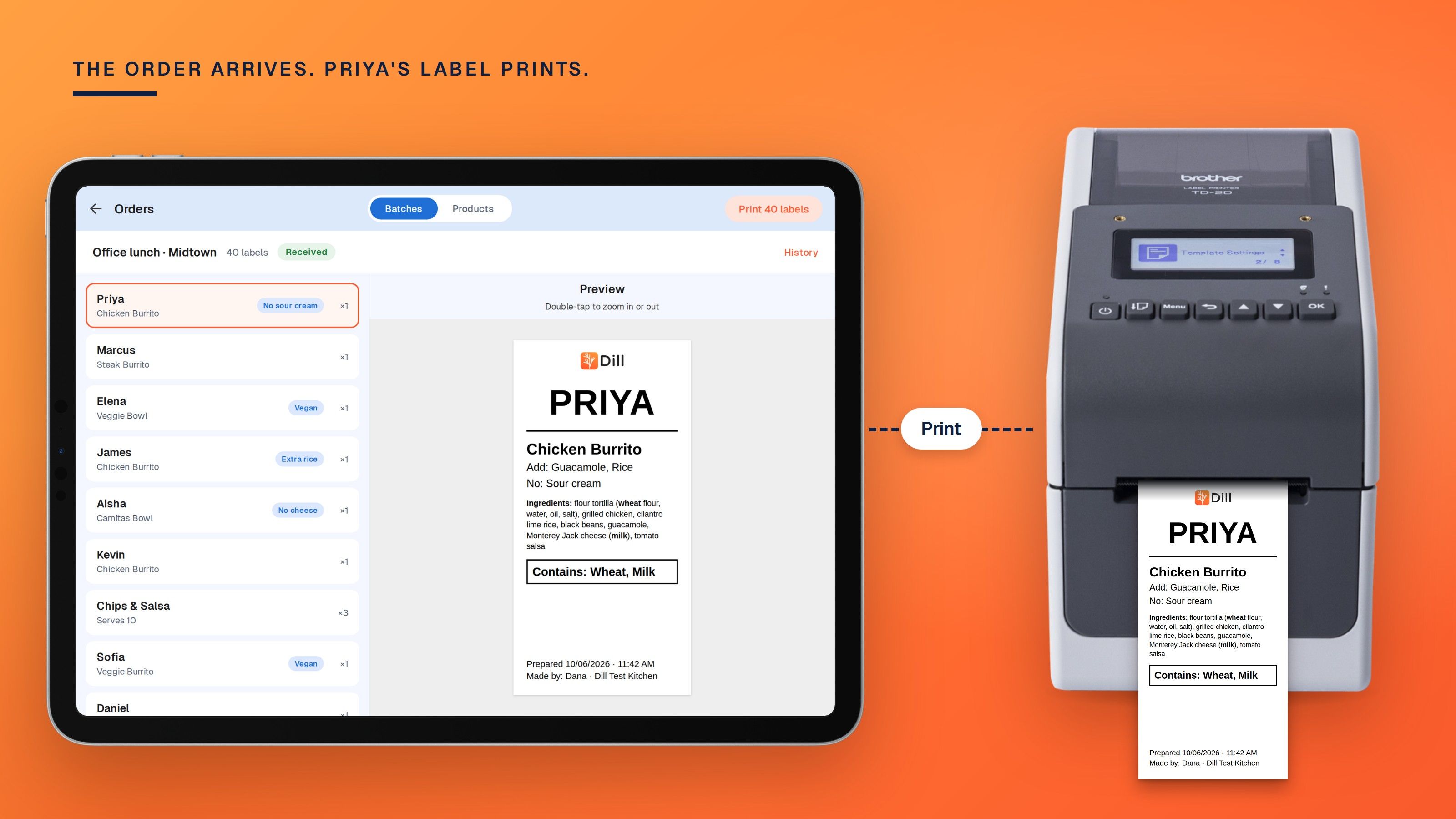
Priya's label says what was removed and why it matters. And the platter, which most kitchens don't label because it isn't "anyone's," is the one most likely to hurt someone. A shared tray of hummus sitting next to 40 boxes needs its own Contains line more than any individual meal does.
A checklist for your next group order
- Get the allergy notes into the order data, not just the email thread. If it's only in a message, it won't make it onto a label.
- Pull allergens from your recipes, not the menu description. The menu says what a dish usually is. The label should say what this one is.
- Label shared trays and platters, with a Contains line, not just individual boxes.
- Print in one run, in packing order. Forty labels printed in the order you'll pack them beats forty cut from a sheet and sorted by hand.
- Have one person check the labels before they print, especially any meal with an allergy note.
- Pack allergy meals last or separately, and put them in the bag on top.
- Keep a record of what printed and when, so you can answer the 2pm phone call.
How Dill handles it
With Dill, ordering platforms, central kitchens and catering brands send print work straight to your site's queue. No re-keying, and no PDFs to download and print.
Work arrives in two shapes. A batch is a named group of labels printed in one run, like the whole 40-person order or a shift's prep list, with a copy count per item. A product is a single line item, printed on its own, like one delivery order that needs one label now.
Staff open the queue on a tablet or phone, check the labels on screen and press Print. Nothing prints without a person confirming, so someone sees every label before it goes on a bag. Each job shows as received, printing, completed or error.
If something goes wrong mid-run, like the printer jams or a label has no template, the run pauses on that label. You see how many printed and which one failed, then retry or cancel. Nothing gets silently skipped, which matters when label 23 of 40 is Priya's.
One batch can mix label sizes, so the boxes and the platter labels come out in the same run, each on its own template's paper.
Allergens and ingredients can come from your recipes in Dill, so the label matches what the kitchen made. Every printed label is logged with the exact values, template, copies and time, viewable by date range. That's your answer to "what did we send out on Tuesday?" No drivers to set up, no label sizes to figure out.
Dill runs on Brother label printers, with other hardware on request, and connects to POS data from Clover, Lightspeed, EposNow, CyBake and PosHub. The same app prints made-to-order labels, prep and rotation labels, and grab-and-go labels. Hundreds of businesses, with thousands of sites between them, have printed over 65 million labels with it.
If you run an ordering platform
If you run a catering, delivery or office meal platform, your vendors are probably printing your labels by hand right now.
With Dill, you send print work straight to each kitchen's Dill queue, as a batch for a group order or a single product for one meal. The label can carry the item name, the customer's first name, course, prepared date, who made it, the business name, modifiers, allergens and dietaries, laid out on the kitchen's own template. You can put your own logo on the label too.
The kitchen checks and prints. Allergens can come from the kitchen's own recipes, so you're not relying on menu data that may be out of date. Every print is logged on the kitchen's side.
Dill is built around the workflow you and your vendors already have, so it adapts as your needs change rather than asking you to rebuild around it. If you run a platform, book a demo and bring one of your group orders.
Book a demo
If you're packing group orders by hand, or you run a platform whose vendors are, we'd be happy to show you how it works. Book a demo.
FAQ
Are allergen labels legally required on catering orders in the US?
Not under federal law. The FDA says its allergen labeling rules don't apply to food placed in a container in response to a customer's order. Some states are moving toward written allergen disclosure, mostly on menus, so check your state, but per-meal labels are good practice rather than a legal requirement.
Does New York's allergen labeling law cover catering and delivery?
No. S5381B covers food that is prepacked and sold on the same premises, and excludes food packaged after a customer orders. It does cover grab-and-go food you pack ahead of time.
What about Canada?
Federal allergen labeling applies to prepackaged products. Made-to-order food isn't prepackaged, so labeling it is good practice, not a federal requirement.
What should go on an individual meal label?
The customer's first name, the dish, modifiers (especially removals), a Contains line for allergens, any dietary tags, the prepared date, who made it and your business name. Shared platters need the same Contains line.
Can I print a whole group order at once?
Yes. With Dill, a group order arrives as a batch and prints in one run, with a copy count per item. Labels in the same batch can use different sizes.
Does Dill print orders automatically?
No, on purpose. Orders land in a queue and a person checks the labels on screen before pressing Print, so someone sees every label before it goes on a bag.
Can I see what we printed last week?
Yes. Every printed label is logged with the exact values, template, copies and time, and you can view the history by date range.