
A quiet shift with national implications
On November 12, 2025, Governor Kathy Hochul signed legislation that makes New York the first state in the country to require allergen labeling on foods that are prepared and packaged on-site — the kind of grab-and-go items you'd find in a deli case, a bakery shelf, or a grocery store's prepared foods aisle. The law takes effect in November 2026, giving food establishments roughly a year to bring their operations into compliance.
For the two million New Yorkers living with food allergies, this closes a gap that's existed for decades. For food brands, retailers, and foodservice operators, it introduces a new layer of compliance work — and likely signals where other states are heading next.
This guide breaks down what the law actually requires, who it covers, and what teams should be doing now to be ready.
What the law requires
The law amends both New York's Public Health Law and Agriculture and Markets Law, adding a written allergen disclosure requirement for any prepackaged food sold by a food establishment.
In plain terms: if your business prepares food, packages it on the premises, and offers it for sale to customers, that package must carry a written notification identifying any of the top nine major allergens present:
- Milk
- Eggs
- Fish
- Crustacean shellfish
- Tree nuts
- Wheat
- Peanuts
- Sesame
- Soybeans
Importantly, the law does not require a full ingredient list. It only requires that the major allergens be clearly identified — either printed on the package itself or on a label affixed to it. This is a deliberate choice: lawmakers wanted to keep the burden on small operators manageable while still giving allergy sufferers the information they need to make safe choices.
Who's covered (and who isn't)
The law applies broadly to "food establishments" that prepare and package food on-site. That includes:
- Delis and sandwich shops
- Bakeries
- Ice cream parlors
- Cafeterias
- Food trucks
- Retail food stores (including grocery store prepared-foods departments)
There are two notable exclusions:
Food packaged after a customer orders it. A custom-made sandwich handed to you in deli paper, a pizza boxed up after you order — these don't trigger the requirement. The law specifically targets pre-prepared, pre-packaged items sitting on a shelf or in a case.
Food that isn't packaged at all. Bulk items, items sold loose, or hot bar offerings without packaging fall outside the law's scope.
The law also incorporates the federal definitions and exemptions from the Food Allergen Labeling and Consumer Protection Act of 2004, meaning highly refined oils derived from major allergens and ingredients that have received FDA exemption petitions are not required to be labeled.
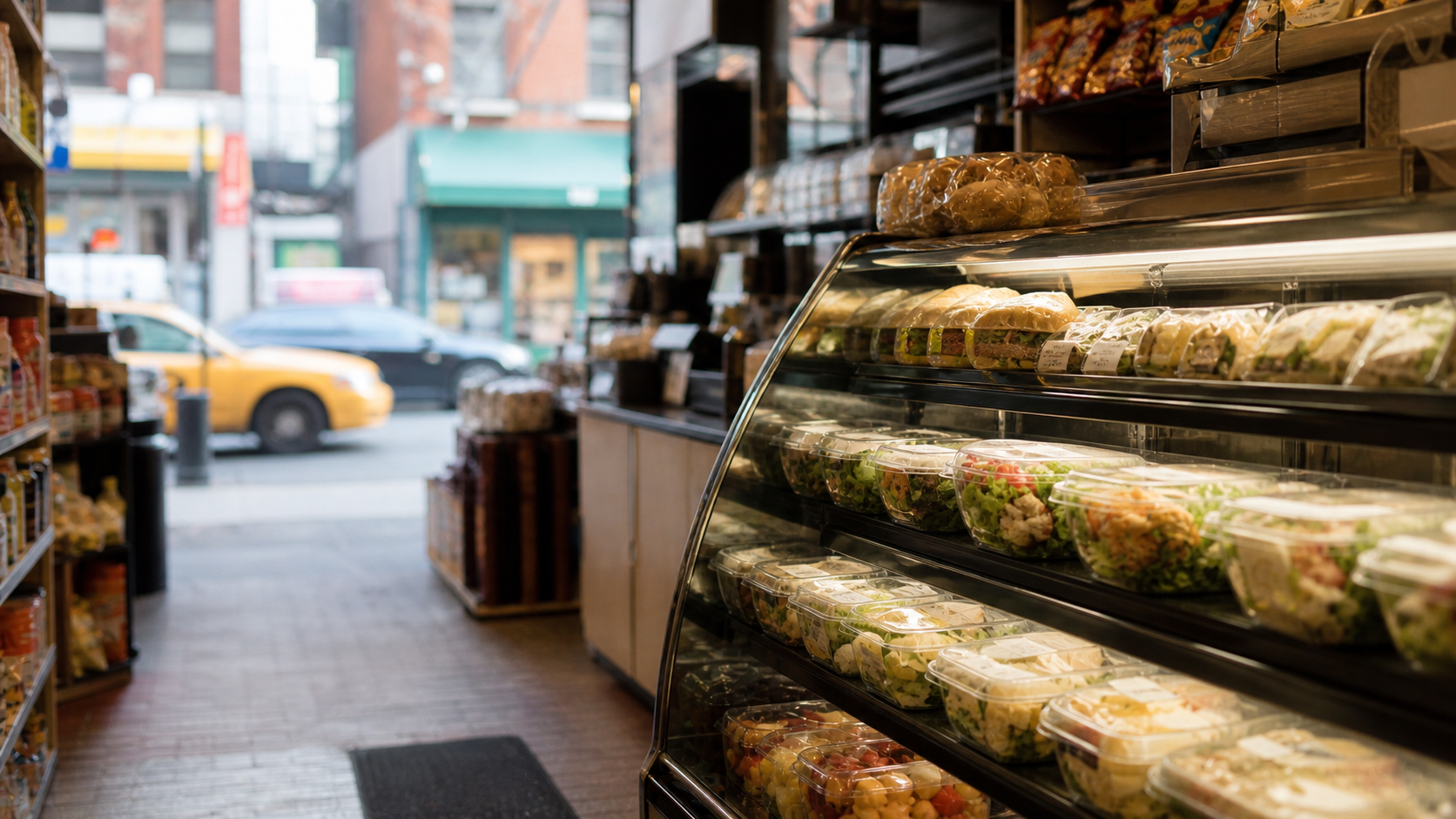
Filename: prepackaged-grab-and-go-deli-case.jpg Alt text: Modern refrigerated deli case displaying prepackaged sandwiches, salads, and wraps with small white labels
Why this matters beyond New York
Federal allergen labeling rules under FALCPA have been in place for over twenty years, but they only apply to foods packaged in industrial settings before being shipped to retail. Foods packaged on-site at the point of sale have always been a regulatory gray zone — even though they make up a significant portion of what consumers buy in delis, bakeries, and grocery stores.
New York's law was modeled on the FDA's 2022 Food Code, which provides voluntary guidance on allergen labeling for retail food establishments. Because New York hasn't formally adopted the Food Code, this legislation effectively codifies that guidance into enforceable state law.
That's significant for two reasons. First, it gives other states a working template — and several have already shown interest in similar legislation. Second, multi-state operators who build compliant labeling workflows for New York will likely find themselves ahead of the curve when neighboring states follow suit.
What compliant labeling looks like
The statute itself is intentionally flexible on format. It requires a written notification on the package, or on a label attached to the package, identifying any ingredient that constitutes a major food allergen.
In practice, this looks similar to the "Contains:" statements already familiar from federally regulated packaged goods — for example, "Contains: Wheat, Milk, Soy." Operators have flexibility on:
- Whether to print directly on packaging or use applied labels
- Visual format (as long as the disclosure is clearly written and legible)
- Whether to also provide a full ingredient list voluntarily
What the law doesn't address — and where operators should still exercise judgment — is precautionary or "may contain" statements. The FDA doesn't regulate these at the federal level, and New York's law doesn't require them. But for products with genuine cross-contact risk in shared production environments, voluntary precautionary labeling remains a best practice.
Operational implications worth thinking about now
Compliance isn't just a labeling exercise — it touches multiple parts of the operation. A few areas that often get underestimated:
Recipe and ingredient documentation. You can't accurately label allergens on the finished product if you don't have current, reliable allergen data on every ingredient going into it. For operators sourcing from multiple suppliers, that means tightening up specification management and supplier documentation.
Reformulation visibility. When a supplier changes a formulation — a new emulsifier with soy lecithin, a switch to a sesame-containing seed blend — the downstream label needs to update too. Without a process for catching ingredient-level changes, allergen labels can quickly fall out of sync with reality.
Cross-contact considerations. The law addresses what's intentionally in the product, not cross-contact. But once you start labeling allergens explicitly, you also create an implicit promise about what's not in the product. Operators should think about whether their production environments support that promise — and whether voluntary precautionary statements are warranted.
Staff training. Front-line employees need to understand the law well enough to answer customer questions accurately, especially during the transition period when some products will be labeled and others may still be catching up.
Label production capacity. For high-mix operators (think a deli with 60+ prepackaged SKUs rotating weekly), the move from no labeling to per-item allergen disclosure can be a meaningful operational lift. Building labeling into prep workflows — rather than treating it as a separate step — tends to scale better than bolt-on solutions.
A reasonable timeline to be ready
With the law taking effect in November 2026, operators have a workable runway — but the back half of that runway tends to fill up fast. A practical sequence:
Now through Q2 2026: Audit your prepackaged SKU list and confirm allergen data on every ingredient. Identify gaps in supplier documentation and request updated specs where needed.
Mid-2026: Finalize label formats, integrate allergen disclosure into your packaging workflows, and run a pilot on a small subset of products to surface practical issues before scaling.
Late summer / early fall 2026: Train staff, update customer-facing materials, and roll out compliant labeling across all prepackaged items.
November 2026: Compliance deadline. By this point, every prepackaged item leaving your premises should carry the required disclosure.
The broader direction of travel
What's happening in New York fits a larger pattern. Allergen disclosure expectations have been steadily expanding — from federal sesame labeling in 2023, to growing pressure for "may contain" standardization, to international frameworks like the UK's Natasha's Law. Consumers increasingly expect transparency about what's in their food, and regulators are catching up.
For food brands and retailers, the operators who treat this as an opportunity to build durable allergen and ingredient infrastructure — rather than a one-time compliance scramble — will be in a much stronger position when the next wave of requirements arrives. And it will arrive.
The November 2026 deadline is a useful forcing function. The work it pushes operators to do is the kind that pays dividends well beyond New York.